
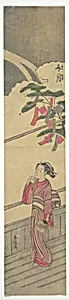
未月|The Seventh Month (Fumizuki)
ca. 1865
Medium
Woodblock print; ink and color on paper
Dimensions
14 x 3 in. (35.6 x 7.6 cm)
Classification
Prints
Culture & Period
Japan · Edo period (1615–1868)
Department
Asian Art
Museum
Metropolitan Museum of Art, New York, NY
Credit
Henry L. Phillips Collection, Bequest of Henry L. Phillips, 1939
Accession Number
JP2767
Rights
Public Domain
Tags
Art Historical Context
Suzuki Harunobu's *The Seventh Month (Fumuki)*, created around 1865 during Japan's Edo period (1615–1868), is a delicate woodblock print in ink and color on paper, a slender 14 x 3 inches. This narrow *hosoban* format was popular in ukiyo-e, the "pictures of the floating world" genre that captured everyday beauty, seasonal themes, and urban life. Harunobu, a master of this tradition, often depicted graceful young girls (*musume*), as suggested by the artwork's tags, evoking innocence amid the humid joys of the seventh lunar month—*fumizuki*—a time linked to summer festivals and fleeting pleasures. As a pioneer of full-color *nishiki-e* prints in the 1760s, Harunobu's influence endured into later Edo reprints like this one from the Henry L. Phillips Collection at the Metropolitan Museum of Art. The medium's brilliance comes from layered woodblocks, each inked in precise hues to achieve subtle gradients and vibrant patterns on handmade paper. This technique democratized art, making luxurious scenes accessible beyond elites. Held in the Asian Art Department's Prints collection, *Fumizuki* reflects Edo Japan's cultural fascination with *mono no aware*—the pathos of things—blending whimsy and transience in scenes of girls at play. A charming window into historical Japan, it invites visitors to savor the era's refined elegance.
About the Artist
Suzuki Harunobu · 1725–1770
Suzuki Harunobu (c. 1725-1770) was a Japanese ukiyo-e artist who revolutionized woodblock printing by developing nishiki-e—full-color prints using multiple woodblocks—in 1765. Before Harunobu, Japanese prints were limited to two or three colors; his innovation unleashed the entire artist's palette, transforming ukiyo-e into the vibrant art form that would later captivate Western artists from Manet...