
The Sheepfold
1857
Medium
Oil on wood
Dimensions
18 1/8 x 36 1/8 in. (46 x 91.8 cm)
Classification
Paintings
Department
European Paintings
Museum
Metropolitan Museum of Art, New York, NY
Credit
Catharine Lorillard Wolfe Collection, Wolfe Fund, 1897
Accession Number
97.40
Rights
Public Domain
Tags
Art Historical Context
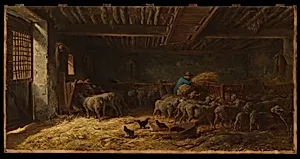
Charles Jacque's *The Sheepfold* (7) captures the quiet rhythms of rural French life in a masterful oil on wood panel, measuring 18 1/8 x 36 1/8 inches. Depicting farmers tending to sheep within a pastoral enclosure, with chickens scattered nearby, the scene evokes the hardworking harmony of 19th-century countryside existence. The elongated format draws the eye across the composition, emphasizing the daily labor of herding and farm work. As a key in the Barbizon School Jacque specialized in animalier painting—realistic portrayals of livestock and rural scenes—influenced by his contemporaries like Jean-François Millet. Painted during the rise of Realism, this work rejects Romantic idealization for earthy authenticity, highlighting the dignity of peasant labor amid natural light and texture. Oil on wood, a durable medium favored for its smooth surface, allowed Jacque's precise brushwork to render woolly sheep and feathered chickens with lifelike detail. Acquired through the Catharine Lorillard Wolfe Collection in 1897, *The Sheepfold* now graces the Metropolitan Museum of Art's European Paintings department. It invites visitors to reflect on the enduring cultural value of pastoral traditions, bridging 19th-century France with our modern appreciation for sustainable, grounded living.
About the Artist
Charles Jacque · 1813–1894
Charles-Émile Jacque (1813–1894) was a pioneering French painter, engraver, and illustrator whose career bridged the worlds of printmaking and pastoral painting. Born in Paris amid a difficult childhood, he apprenticed at age seventeen to a map engraver, mastering drypoint technique and producing his first etching in 1830—a copy of a head after Rembrandt. After serving seven years in the French Ar...