
The Shepherdess
c. 1869
Medium
pastel on brown wove paper
Dimensions
overall: 52.6 x 94.9 cm (20 11/16 x 37 3/8 in.)
Classification
Drawing
Department
CG-E
Museum
National Gallery of Art, Washington, D.C.
Credit
Gift of Mr. and Mrs. James T. Dyke
Accession Number
1996.45.1
Rights
Public Domain
Art Historical Context
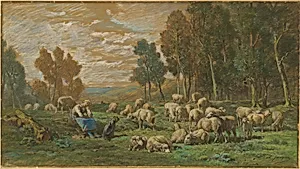
**The Shepherdess** (c. 1869) by Charles Émile Jacque the serene essence of rural French life, a hallmark of the artist's career. Jacque, a prominent member of the Barbizon School Jean-François Millet and Théodore Rousseau, celebrated the everyday labors of peasants and shepherds in the Fontainebleau forest region. This large-scale drawing likely portrays a young shepherdess amid pastoral landscapes, reflecting the 19th-century Romantic idealization of nature and honest toil amid France's industrializing society. Rendered in pastel on brown wove paper, the work showcases Jacque's mastery of this luminous medium. Pastels allowed for vibrant, atmospheric effects—soft blends of color evoking misty fields and warm sunlight—while the tinted brown paper provided a ready-made earthy ground, enhancing depth and unity. At 52.6 x 94.9 cm, its expansive format suggests it was conceived as an independent artwork, not merely a study, emphasizing Jacque's skill in bridging drawing and painting traditions. Now in the National Gallery of Art's Prints and Drawings collection (gift of Mr. and Mrs. James T. Dyke), **The Shepherdess** exemplifies Jacque's contributions to Realism, inviting viewers to pause and appreciate the timeless beauty of the countryside. A testament to 19th-century draftsmanship, it reminds us of art's power to preserve vanishing rural idylls.