
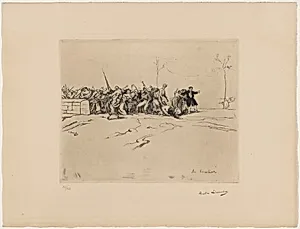
The Shield (Le Bouclier)
1915-1917
Medium
etching with roulette on buff wove paper
Dimensions
plate: 23.97 × 29.85 cm (9 7/16 × 11 3/4 in.) sheet: 36.83 × 48.26 cm (14 1/2 × 19 in.)
Classification
Department
CG-E
Museum
National Gallery of Art, Washington, D.C.
Credit
Ailsa Mellon Bruce Fund
Accession Number
2019.65.1.10
Rights
Public Domain
Art Historical Context
**The Shield (Le Bouier)**, created by French artist André Devambez 1915 and 1917, captures a pivotal moment during World War I. Devambez, a distinguished printmaker and painter known for his meticulous historical and allegorical works, produced this etching amid the height of the conflict that engulfed Europe. The title evokes themes of protection and resilience, resonating with France's fierce defense against invasion—a poignant symbol in an era of unprecedented destruction. Rendered in etching with roulette on buff w paper, the work showcases Devambez's mastery of intaglio techniques. Etching allows for fine, expressive lines, while the roulette—a toothed wheel—adds subtle tonal textures, enhancing depth and atmosphere on the warm-toned sheet (36.83 × 48.26 cm). This medium was ideal for producing detailed, reproducible images that could convey powerful narratives to wide audiences, blending technical precision with emotional impact. Housed in the National Gallery of Art's Department of Prints (acquired via the Ailsa Mellon Bruce Fund), *The Shield* exemplifies early 20th-century French printmaking's role in wartime visual culture. Devambez's academic style, rooted in narrative clarity, invites viewers to reflect on human endurance, making it a compelling piece for exploring art's intersection with history.