
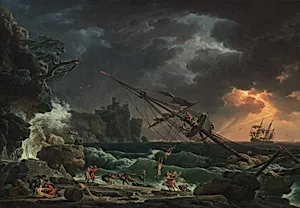
The Shipwreck
Medium
oil on canvas
Dimensions
overall: 113.5 x 162.9 cm (44 11/16 x 64 1/8 in.) framed: 124.8 x 172.9 x 7.6 cm (49 1/8 x 68 1/16 x 3 in.)
Classification
Painting
Department
CF
Museum
National Gallery of Art, Washington, D.C.
Credit
Patrons' Permanent Fund and Chester Dale Fund
Accession Number
2000.22.1
Rights
Public Domain
Art Historical Context
Claude-Joseph Vernet, one of the leading French marine painters of the eighteenth century, created *The Shipwreck* in 1772 as a powerful example of his dramatic seascapes. Working primarily in oil on canvas,et specialized in scenes that capture the raw force of nature, drawing on a tradition of Dutch marine art while infusing his compositions with heightened emotion and theatrical lighting. This large-scale painting, measuring over four feet in height, invites viewers to witness the chaos of a vessel caught in a violent storm. The work reflects the period’s fascination with the sublime—the awe-inspiring and sometimes terrifying aspects of the natural world. Vernet’s careful rendering of churning waves, wind-swept sails, and figures struggling against the elements demonstrates his technical skill in depicting light, atmosphere, and movement. Such subjects were immensely popular with collectors and royal patrons, who admired both the visual spectacle and the moral undertones of human resilience. Today housed in the National Gallery of Art, *The Shipwreck* continues to engage audiences with its timeless portrayal of nature’s power and humanity’s vulnerability at sea.
About the Artist
Claude-Joseph Vernet · 1714–1789
Claude-Joseph Vernet and his direct descendants are the last representatives of the Avignon School which had provided a continuous line of artists since the 14th century. It originated at the time when Bernard de Goth, Archbishop of Bordeaux, became pope in the name of Clement V and transferred the seat of the papacy to Avignon where he established an influential artistic community. Comment on wor...