
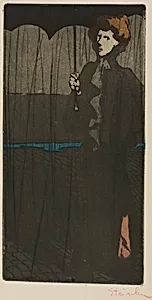
The Shower
Medium
Aquatint and drypoint from two zinc plates printed à la poupée in 6 colors (black, dark gray, medium gray, brown, blue and pink) on ivory laid paper
Dimensions
Image/plate: 24.1 × 12.2 cm (9 1/2 × 4 13/16 in.); Sheet: 42.5 × 30.2 cm (16 3/4 × 11 15/16 in.)
Classification
aquatint
Department
Prints and Drawings
Museum
Art Institute of Chicago
Accession Number
49650
Rights
Public Domain
Art Historical Context
**The Shower**, created by Swiss-born French artist Théophile-Alexandre Steinlen in 1898, captures an intimate moment of everyday life through masterful printmaking. Steinlen, renowned for his depictions of Parisian working-class scenes and his iconic cat posters during the Belle Époque, a tender realism to this work. Housed in the Art Institute of Chicago's Prints Drawings department, the image measures a compact 24.1 × 12.2 cm, printed on ivory laid paper. This aquatint and drypoint executed from two zinc plates and printed *à la poupée* in six vibrant colors—black, dark gray, medium gray, brown, blue, and pink—showcases Steinlen's innovative technique. *À la poupée* inking, where colors are applied by hand with fabric-wrapped "dolls," allowed for subtle tonal gradations and rich, painterly effects rare in prints of the era. Aquatint provides soft, velvety textures mimicking watercolor, while drypoint adds delicate, expressive lines, highlighting the medium's versatility for nuanced emotional depth. In the context of fin-de-siècle Paris, Steinlen's work reflects the era's fascination with urban modernity and human vulnerability, bridging Art Nouveau's elegance with social realism. *The Shower* invites viewers to appreciate the artistry in ordinary rituals, a testament to Steinlen's empathy for the humble lives around Montmartre's cabarets.
About the Artist
Théophile-Alexandre Pierre Steinlen · 1859–1923
Théophile Alexandre Steinlen, born on November 10, 1859, in Lausanne, Switzerland, grew up in an environment steeped in artistic influence, with his grandfather serving as a drawing teacher in nearby Vevey. He studied literature at the University of Lausanne before working as a designer trainee in a Mulhouse textile mill. In his early twenties, around 1881, Steinlen married Émilie Mey, and the cou...