
The Silver Tureen
ca. 1728–30
Medium
Oil on canvas
Dimensions
30 x 42 1/2 in. (76.2 x 108 cm)
Classification
Paintings
Department
European Paintings
Museum
Metropolitan Museum of Art, New York, NY
Credit
Fletcher Fund, 1959
Accession Number
59.9
Rights
Public Domain
Tags
About this artwork
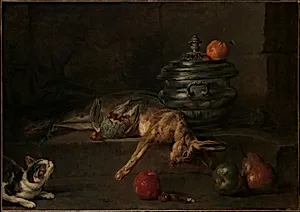
This masterful still life marks Jean Siméon Chardin's brilliant emergence as eighteenth-century France's preeminent painter of the genre. Created around 1728-1730, shortly after his admission to the French Royal Academy in 1728, the painting announces the arrival of an artist who would transform still life from decorative exercise into profound meditation on material existence. The substantial composition contrasts living and dead, raw and cooked: a supple, crouching cat provides vital energy ag...
Art Historical Context
Jean Siméon Chardin'sThe Silver Tureen*ca. 1728–30) is a landmark still life in oil on canvas, marking the artist's rise as eighteenth-century France's master of the genre. Painted shortly after his 1728 admission to the Royal Academy, it elevates everyday objects into profound symbols of life and materiality. Measuring 30 x 42½ inches, this work from the Metropolitan Museum of Art's European Paintings collection a harmonious arrangement of fruits like apples and oranges, a dead hare and partridge, and a lively crouching cat—juxtaposing vitality against stillness, raw against cooked. Chardin's genius shines in his virtuoso handling of textures and light: the soft fur of the cat and feathers of the birds contrast with the crisp orange rind and the gleaming, reflective silver tureen, where subtle color reflections reveal his deep understanding of optics. Far from mere decoration, the painting's rough impasto reminds us of the artist's hand, infusing humble domestic scenes with quiet dignity. An intriguing anecdote notes Chardin may have traded this very piece for a jacket with engraver Jacques-Philippe Le Bas. Acquired by the Met in 1959 via the Fletcher Fund, it exemplifies how Chardin transformed still life into a meditative art form, influencing generations with its balanced composition and emotional depth.
About the Artist
Jean Siméon Chardin · 1699–1779
Jean-Baptiste-Siméon Chardin, born on November 2, 1699, in Paris to a cabinetmaker father who crafted billiard tables, grew up immersed in the city's artisan world on the Left Bank near Saint-Sulpice. His early training came through apprenticeships with the history painters Pierre-Jacques Cazes, where he honed academic drawing techniques, and Noël-Nicolas Coypel, whose assignment to copy a musket ...