
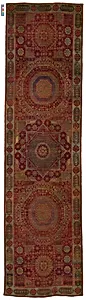
The 'Simonetti' Carpet
Unknown Artist
ca. 1500
Medium
Wool (warp, weft, and pile); asymmetrically knotted pile
Dimensions
Rug: L. 353 in. (896.6 cm) W. 94 in. (238.8 cm) Tube: H. 106 in. (269.2 cm) Diam. 10 in. (25.4 cm)
Classification
Textiles-Rugs
Department
Islamic Art
Museum
Metropolitan Museum of Art, New York, NY
Credit
Fletcher Fund, 1970
Accession Number
1970.105
Rights
Public Domain
Art Historical Context
The 'Simonetti' Carpet, created around 1500, stands as a remarkable example of early Islamic textile artistry. Woven from wool using the asymmetrically knotted pile technique—commonly known as the Persian knot—this large rug measures nearly 30 feet in length, suggesting it may have served as a grand floor covering for a palace or mosque. Its exceptional scale and craftsmanship highlight the sophisticated weaving traditions flourishing across the Islamic world at the turn of the sixteenth century. This anonymous masterpiece reflects the cultural importance of carpets as both functional objects and symbols of wealth and refinement. The use of wool throughout the warp, weft, and pile allowed for durability and rich texture, while the knotting method enabled intricate designs that have endured for centuries. Acquired by the Metropolitan Museum through the Fletcher Fund in 1970, the carpet offers visitors a tangible connection to the vibrant artistic exchanges of the period. Today, it invites appreciation for the skill of unknown weavers whose work blended utility with aesthetic beauty, preserving a legacy of Islamic design innovation.