
The Sistine Madonna
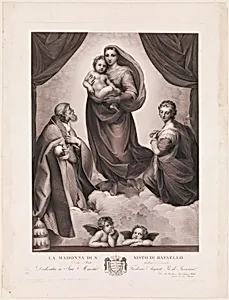
Medium
Etching and engraving; fourth state of seven
Dimensions
plate: 30 1/4 x 22 in. (76.8 x 55.9 cm) sheet: 34 3/4 x 26 1/2 in. (88.3 x 67.3 cm)
Classification
Prints
Department
Drawings and Prints
Museum
Metropolitan Museum of Art, New York, NY
Credit
Gift of Junius S. Morgan, 1923
Accession Number
23.106.52
Rights
Public Domain
Tags
Art Historical Context
Behold *The Sistine Madonna*, a etching and engraving that captures the essence of Raphael's High Renaissance masterpiece, originally painted around 1512–13 for the church of San Sisto in Piacenza, Italy. This print, in its fourth state of seven, reproduces the iconic composition: the serene Madonna descending from heaven with the Christ Child in her arms, flanked by the cherubic angels at the base—now beloved cultural icons—and saints like Sixtus and Barbara. Raphael (Raffaello Sanzio), a pinnacle of Renaissance humanism, infused the scene with graceful harmony, ideal beauty, and emotional depth, making it one of the most reproduced images in art history. Crafted by skilled printmakers including Johann Friedrich Wilhelm Müller, Rittner, and Seidelmann, this large-scale work (plate 30¼ × 22 in.) exemplifies 19th-century reproductive printmaking. Etching and engraving techniques allowed intricate details—from the Madonna's flowing drapery to the angels' tender gazes—to be disseminated widely, bringing Raphael's vision to collectors and admirers far beyond Europe's elite. The progressive "states" reflect refinements in the plate, heightening its value as a connoisseur's piece. Now in the Metropolitan Museum of Art's Drawings and Prints department, gifted by Junius S. Morgan in 1923, it invites us to ponder the Madonna's enduring role as a symbol of divine motherhood and artistic perfection.