
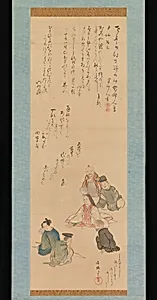
窪俊満筆 六歌仙図|The Six Poetic Immortals
ca. 1810
Medium
Hanging scroll; ink and color on silk
Dimensions
36 × 12 3/4 in. (91.4 × 32.4 cm)
Classification
Paintings
Culture & Period
Japan · Edo period (1615–1868)
Department
Asian Art
Museum
Metropolitan Museum of Art, New York, NY
Credit
Gift of Sebastian Izzard and Masaharu Nagano, in memory of T. Richard Fishbein, 2014
Accession Number
2014.727
Rights
Public Domain
Tags
Art Historical Context
In the elegant hanging scroll *The Six Poetic Immals* (Rokkasen-zu), created around 1810 by Kubo Shun during Japan's Edo period (1615–1868), we encounter vivid portrayals of legendary waka poets—both men and women—who shaped classical Japanese literature. These "immortals," including figures like Ono no Komachi Ariwara no Nariira, were revered for their mastery of 31-syllable poems evoking love, nature, and impermanence. Shunman's work immortalizes them in a timeless tableau, blending historical homage with imaginative flair typical of ukiyo-e influences in painting. Rendered in ink and color on silk—a luxurious medium prized for its luminous sheen and suitability for vertical display in homes or alcoves—this 36 × 12¾-inch scroll exemplifies Edo-era refinement. The technique allows delicate gradations of color and fluid ink lines, capturing the poets' poetic grace and individuality. Such depictions were culturally significant, inspiring admiration for literary heritage amid the period's urban sophistication and woodblock print boom. A gift to the Metropolitan Museum of Art in 2014, this piece invites visitors to ponder how art bridges eras, honoring voices from the Heian court (794–1185) through Shunman's discerning brush. (198 words)
About the Artist
Kubo Shunman · 1757–1820
Japanese, 1757–1820