
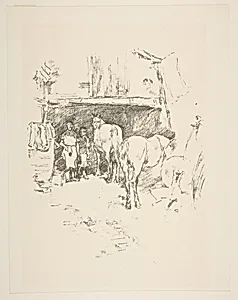
The Smith's Yard, from "The International Studio"
Medium
Transfer lithograph; only state (Chicago), as published; printed from a supplementary stone on medium-weight ivory wove paper with a smooth finish
Dimensions
Image: 7 1/2 × 6 1/4 in. (19.1 × 15.8 cm) Sheet: 10 1/16 × 7 5/8 in. (25.5 × 19.3 cm)
Classification
Prints
Department
Drawings and Prints
Museum
Metropolitan Museum of Art, New York, NY
Credit
Harris Brisbane Dick Fund, 1917
Accession Number
17.3.228
Rights
Public Domain
Tags
Art Historical Context
James McNeill Whistler, the renowned American-born artist celebrated for his subtle tonal harmonies and association with the Aesthetic movement, everyday urban life in *The Smith's Yard* (1895). This intimate transfer lithograph depicts a blacksmith's yard, alive with men and horses amid the clang of hammers and forge fires. Published as part of *The International Studio* magazine, it reflects Whistler's fascination with London's working-class scenes, rendered with his signature economy of line and atmospheric depth. Printed in a single state from Chicago on smooth, medium-weight ivory wove paper, the work showcases Whistler's mastery of transfer lithography—a technique where drawings were photographically transferred to lithographic stone for precise, velvety reproductions. Measuring just 7½ × 6¼ inches, its compact scale invites close viewing, emphasizing texture and shadow over fine detail, much like his famous nocturnes in oil. Acquired by The Metropolitan Museum of Art through the Harris Brisbane Dick Fund in 1917, this print highlights Whistler's innovative printmaking in the late 19th century, bridging fine art and popular illustration while preserving glimpses of industrial-era life. A gem for print enthusiasts, it reveals the poetry in the prosaic.
About the Artist
James McNeill Whistler · 1834–1903
James Abbott McNeill Whistler (1834-1903) was an American-born painter and printmaker who became a leading figure in the Aesthetic Movement and pioneer of Tonalism and Japonisme. He revolutionized art by championing "art for art's sake" and treating paintings as visual equivalents of musical compositions, titling works as "arrangements," "harmonies," and "nocturnes" to emphasize formal qualities o...