
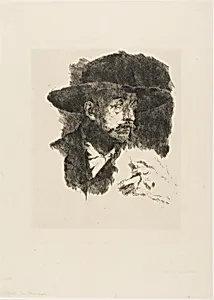
The Smoker
1873/74
Medium
Etching on ivory Japanese paper
Dimensions
Plate: 22.8 × 18.5 cm (9 × 7 5/16 in.); Sheet: 33.9 × 24.1 cm (13 3/8 × 9 1/2 in.)
Classification
etching
Department
Prints and Drawings
Museum
Art Institute of Chicago
Accession Number
158873
Rights
Public Domain
Art Historical Context
### The Smoker by Wilhelm Leibl Wilhelm Leibl's *The Smoker* (1873/74) captures the quiet intensity of everyday life through the lens of German Realism. Leibl, a leading figure in the Leibl-Kreis group of artists, drew inspiration from Gustave Courbet, favoring unidealized portraits of peasants and ordinary folk over romanticized subjects. Created during his mature period, this etching likely portrays a contemplative figure puffing on a pipe, embodying the artist's commitment to truthful observation and psychological depth. Printed on luxurious ivory Japanese paper—a favored medium among 19th-century printmakers for its soft texture and ability to hold fine ink details—the work measures a modest plate size of 22.8 × 18.5 cm. Etching allowed Leibl to achieve remarkable precision: lines incised into a metal plate with acid create rich, velvety tones and subtle textures, from the smoke's haze to fabric folds. This technique elevated prints from mere reproductions to independent artworks, showcasing Leibl's mastery in the Prints and Drawings tradition. Housed in the Art Institute of Chicago, *The Smoker* reflects the era's fascination with meticulous realism amid rapid industrialization. Its intimate scale invites close viewing, revealing Leibl's skill in transforming the mundane into the profound—a testament to how 19th-century etchings bridged painting and graphic art for broader audiences.
About the Artist
Wilhelm Leibl · 1844–1900
Wilhelm Leibl (1844–1900) was the foremost German Realist painter of the nineteenth century, a figure who dedicated his career to an uncompromising fidelity to observed reality at a time when idealized academic painting still dominated official taste. Born in Cologne, he studied at the Munich Academy under Karl von Piloty, but the decisive influence on his development came from his encounter with ...