
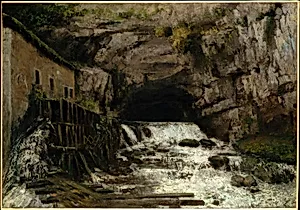
The Source of the Loue
1864
Medium
Oil on canvas
Dimensions
39 1/4 x 56 in. (99.7 x 142.2 cm)
Classification
Paintings
Department
European Paintings
Museum
Metropolitan Museum of Art, New York, NY
Credit
H. O. Havemeyer Collection, Bequest of Mrs. H. O. Havemeyer, 1929
Accession Number
29.100.122
Rights
Public Domain
Tags
Art Historical Context
In 1864, Gustave Cour, a pioneering French Realist painter, captured the raw beauty of his native Franche-Comté region in *The Source of the Lou*. This oil on canvas depicts the mysterious emergence of the Loue River a cavern in the Jura Mountains a site Courbet knew intimately. Rejecting the idealized landscapes of Romanticism, Realism emphasized unvarnished nature and everyday truths, positioning Courbet as a rebel against academic conventions during France's Second Empire. Courbet's masterful technique shines through thick impasto strokes that mimic the rocky textures, foaming water, and misty atmosphere, inviting viewers to feel the cool dampness of the grotto. At 39¼ x 56 inches, the large-scale canvas immerses us in the scene's dramatic scale, highlighting the river's life-giving power—a metaphor for nature's untamed vitality. Now part of the H.O. Havemeyer Collection at The Metropolitan Museum of Art, this work exemplifies Courbet's commitment to painting *en plein air* influences and his influence on later Impressionists, offering a timeless tribute to the Loue's enigmatic source.
About the Artist
Gustave Courbet · 1819–1877
Jean Désiré Gustave Courbet (1819-1877) was a French painter who revolutionized 19th-century art as the founding figure of the Realism movement. Born in Ornans, a small town in the Doubs region of France, Courbet came from a prosperous farming family with anti-monarchical roots—his maternal grandfather had participated in the French Revolution. This background shaped his lifelong commitment to dep...