
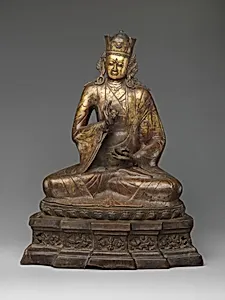
The Spiritual Master Padmasambhava
Unknown Artist
14th century
Medium
Copper alloy with copper and silver inlay
Dimensions
H. 23 3/4 in. (60.3 cm); W. 18 3/4 in. (47.6 cm); D. 13 in. (33 cm)
Classification
Sculpture
Culture
Western Tibet or Ladakh
Department
Asian Art
Museum
Metropolitan Museum of Art, New York, NY
Credit
Zimmerman Family Collection, Purchase, Lila Acheson Wallace, The Vincent Astor Foundation, Eliot C. Nolen, T. Rowe Price Services, Inc. and Sir Joseph Hotung Gifts; Seymour and The Miriam and Ira D. Wallach Foundation Funds, 2012
Accession Number
2012.459
Rights
Public Domain
Tags
Art Historical Context
This striking 14th-century sculpture portrays Padmasambhava, the revered Indian tantric master credited with establishing Buddhism in Tibet during the 8th century Created in the Himalayan region of western Tibet or Ladakh, the work reflects the deep spiritual traditions of Tibetan Buddhism, where Padmasambhava—often called Guru Rinpoche—is venerated as a protector and teacher who overcame obstacles to spread the faith. The figure’s commanding presence, with its detailed inlaid features, invites viewers to connect with centuries of devotional practice in remote mountain monasteries. Crafted from copper alloy with delicate copper and silver inlays, the sculpture demonstrates the sophisticated metalworking techniques of Himalayan artisans. These inlays were skillfully used to highlight eyes, lips, and ornaments, creating a lifelike quality that enhances the figure’s spiritual aura. Such materials also ensured durability in the harsh high-altitude environments where these images were displayed. As a rare surviving example from this period, the piece offers insight into the artistic exchanges along ancient trade routes between India, Tibet, and Central Asia. It embodies the fusion of religious devotion and masterful craftsmanship that continues to inspire audiences today.