
The Storm
Medium
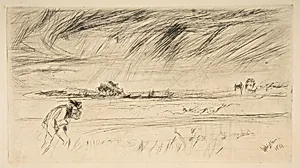
Drypoint; third state of three, from the cancelled plate as published in 1879 by the Fine Art Society (Glasgow); printed in black ink on ivory laid paper
Dimensions
Plate: 6 3/16 × 11 3/16 in. (15.7 × 28.4 cm) Sheet: 8 1/8 × 12 1/2 in. (20.6 × 31.8 cm)
Classification
Prints
Department
Drawings and Prints
Museum
Metropolitan Museum of Art, New York, NY
Credit
Gift of James N. Rosenberg, 1957
Accession Number
57.609.26
Rights
Public Domain
Tags
Art Historical Context
James McNeill Whistler’s *The Storm* (1861) captures the raw drama of nature’s fury through the intimate medium of drypoint, a technique where the artist scratches directly into a copper plate to create rich, velvety lines the burr raised by the tool. This print, the third and final state of three from cancelled plate—intentionally scratched to halt further impressions—was published in 1879 by the Fine Art Society in Glasgow. Printed in black ink on ivory laid, its modest plate size of 6 3/16 × 11 3/16 inches evokes a sense of immediacy, as if glimpsed amid the tempest. Created during Whistler’s formative years in London, when he was pioneering innovative printmaking influenced by Realism and Japanese aesthetics, *The Storm* showcases his mastery of tone and atmosphere. Tags hint at male figures battling stormy seas, aligning with Whistler’s fascination with fleeting natural effects and human resilience. As part of the Metropolitan Museum of Art’s Drawings and Prints collection—gifted by James N. Rosenberg in 1957—this work exemplifies 19th-century printmaking’s evolution from reproductive art to expressive poetry, inviting viewers to feel the wind’s howl and waves’ crash. Whistler’s prints, like this one, revolutionized the genre by prioritizing mood over detail, influencing modernists and collectors alike. A perfect gem for contemplating art’s power to distill chaos into calm.
About the Artist
James McNeill Whistler · 1834–1903
James Abbott McNeill Whistler (1834-1903) was an American-born painter and printmaker who became a leading figure in the Aesthetic Movement and pioneer of Tonalism and Japonisme. He revolutionized art by championing "art for art's sake" and treating paintings as visual equivalents of musical compositions, titling works as "arrangements," "harmonies," and "nocturnes" to emphasize formal qualities o...