
The Stranded Ship
Asher Brown Durand, 1844
About this artwork
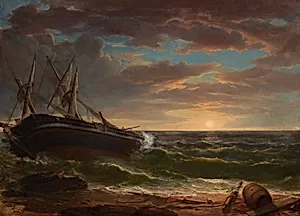
Asher B. Durand's *The Stranded Ship* (1844) captures the raw power of nature, a hallmark of the Hudson River School, the first major American art movement celebrating the continent's sublime landscapes. Durand, a founding member alongside Thomas Cole, shifted from engraving to painting after a formative 1840 trip to Europe, where he studied Old Masters like Claude Lorrain. This oil on canvas reflects that influence, blending meticulous detail with Romantic drama—likely portraying a vessel wrecked amid turbulent seas, underscoring humanity's fragility before the elements. Painted at 94 x 129.5 cm, the work's grand scale invites viewers into an immersive scene, with oil's rich textures allowing Durand to render foaming waves, stormy skies, and rugged shores with luminous precision. As a luminist precursor, it emphasizes light's transcendent effects, a technique Durand championed in his influential 1855 essay "Letters on Landscape Painting," urging artists to study nature directly. Now at the National Gallery of Art, thanks to a generous gift from Ann and Mark Kington through the Kington Foundation, *The Stranded Ship* embodies 19th-century America's growing national pride in its wilderness, reminding us of art's power to evoke awe and reflection.