
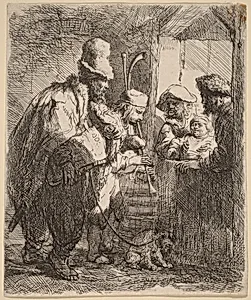
The Strolling Musicians
c. 1635
Medium
etching
Classification
Department
CG-E
Museum
National Gallery of Art, Washington, D.C.
Credit
Rosenwald Collection
Accession Number
1943.3.7241
Rights
Public Domain
Art Historical Context
In the heart of the Dutch Golden Age, Rembrandt vanijn created *The Strolling Musicians around 1635, a masterful etching that captures the lively spirit of itinerant performers wandering Europe's streets. Rembrandt, a Baroque genius known for his dramatic use of light and shadow (chiaroscuro), often turned his gaze to everyday folk—beggars, musicians, and rogues—infusing them with profound humanity and caricature-like expressiveness. This print depicts a trio of ragged figures with instruments, their animated poses evoking the vibrant, precarious life of street entertainers in 17th-century Holland. As an etching, the work showcases Rembrandt's revolutionary printmaking techniques. He skillfully combined etched lines with drypoint burrs to achieve velvety textures and tonal depth, rivaling the richness of his oil paintings. Etchings like this were affordable reproductions, allowing wider audiences to own Rembrandt's art, and this one exemplifies his innovative approach to capturing movement and emotion on a small copper plate. Housed in the National Gallery of Art's Rosenwald Collection (Department CG-E), *The Strolling Musicians* highlights Rembrandt's enduring influence on printmaking and genre scenes. It's a window into a world of social observation, reminding us how one artist's keen eye turned humble wanderers into timeless icons of resilience and joy.
About the Artist
Rembrandt van Rijn · 1606–1669
Rembrandt Harmenszoon van Rijn (1606–1669) stands as one of the greatest visual artists in the history of Western art and the most important Dutch painter of the 17th century. Born in Leiden to a prosperous miller's family, Rembrandt transformed painting through his revolutionary use of light and shadow, his psychological depth in portraiture, and his elevation of etching to a fine art. His approx...