
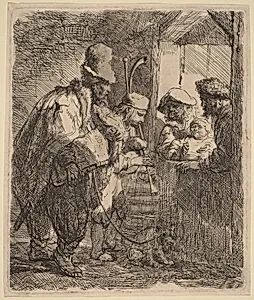
The Strolling Musicians
c. 1635
Medium
etching
Dimensions
plate: 14 x 11.7 cm (5 1/2 x 4 5/8 in.) sheet: 14.3 x 12.2 cm (5 5/8 x 4 13/16 in.)
Classification
Department
CG-E
Museum
National Gallery of Art, Washington, D.C.
Credit
Rosenwald Collection
Accession Number
1943.3.7242
Rights
Public Domain
Art Historical Context
### The Strolling Musicians brandt van Rijn'sThe Strolling Musicians (c. 1635) is a captivating etching from the Dutch master's early maturity, created during the height of the Dutch Golden Age. This small print (plate: 14 x 11.7 cm) depicts itinerant musicians wandering through a landscape, embodying the everyday vitality of 17th-century Europe. Rembrandt, renowned for his Baroque style blending dramatic light, rich textures, and profound human observation, often turned to such genre scenes to explore ordinary lives with extraordinary depth. Etching allowed Rembrandt to innovate beyond painting, using acid to bite intricate lines into copper plates for reproducible prints that reached wide audiences. In this work, he masterfully employs cross-hatching and drypoint for velvety shadows and luminous highlights, creating a sense of movement and intimacy despite the modest dimensions. Multiple states of the plate reveal his meticulous refinements, showcasing his technical brilliance. Housed in the National Gallery of Art's Rosenwald Collection, this print highlights Rembrandt's pivotal role in elevating printmaking to fine art. It invites visitors to appreciate how a fleeting moment of music-making captures enduring cultural rhythms of the era.
About the Artist
Rembrandt van Rijn · 1606–1669
Rembrandt Harmenszoon van Rijn (1606–1669) stands as one of the greatest visual artists in the history of Western art and the most important Dutch painter of the 17th century. Born in Leiden to a prosperous miller's family, Rembrandt transformed painting through his revolutionary use of light and shadow, his psychological depth in portraiture, and his elevation of etching to a fine art. His approx...