
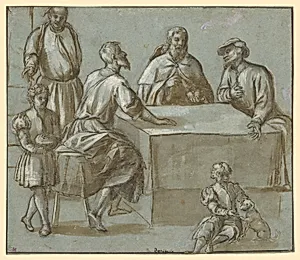
The Supper at Emmaus
mid-16th century
Medium
Brush and brown ink, brown wash, heightened with white, over black chalk underwriting, on blue paper.
Dimensions
10 1/4 x 11 3/4 in. (26.1 x 29.9 cm)
Classification
Drawings
Department
Robert Lehman Collection
Museum
Metropolitan Museum of Art, New York, NY
Credit
Robert Lehman Collection, 1975
Accession Number
1975.1.543
Rights
Public Domain
Tags
Art Historical Context
In the hushed glow of the Robert Lehman Collection at The Metropolitan Museum of Art lies *The Supper at Emmaus*, captivating mid-16th-century by Bonifacio de' Pit, known as Bonifacio Veronese This Venetian Renaissance master captures a pivotal biblical moment from the Gospel of Luke: the Christ revealing himself to two disciples over a humble supper. The intimate scene, centered on male figures including Christ, pulses with narrative drama, inviting viewers to ponder themes of recognition and faith that resonated deeply in Counter-Reformation Europe. Executed with virtuoso technique, the work employs brush and brown ink, brown wash, and white heightening over black chalk on toned blue paper—a favored Renaissance method for luminous studies. The blue ground evokes shadowy depth, while washes and highlights sculpt forms with dramatic chiaroscuro, echoing the coloristic innovations of Titian and Giorgione, Veronese's influences. At 10¼ x 11¾ inches, its compact scale belies its preparatory power, likely a modello for a larger painting, showcasing the artist's fluid line and atmospheric modeling. This gem from the 1975 Lehman bequest offers a window into Venetian draftsmanship's golden age, blending piety with artistic experimentation. Pause here to appreciate how such drawings bridged studio sketch and altarpiece, enriching the era's devotional art.