
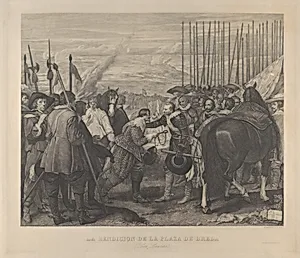
The Surrender at Breda or 'Las Lanzas' (The Lances), after Velázquez
Medium
Etching on wove paper
Dimensions
Sheet: 24 3/16 × 29 1/2 in. (61.4 × 74.9 cm) Plate: 19 × 22 1/4 in. (48.3 × 56.5 cm)
Classification
Prints
Department
Drawings and Prints
Museum
Metropolitan Museum of Art, New York, NY
Credit
Gift of Maurice and Yvette Bendahan, 2013
Accession Number
2013.998.3
Rights
Public Domain
Tags
Art Historical Context
This etching by Bartolomé Maura, created in 1876, reproduces Diego Velázquez’s celebrated 1634–35 painting *The Surrender of Breda*. The original canvas commemorates the 1625 Spanish victory during the Eighty Years’ War, when Dutch commander Justinus of Nassau formally presented the city keys to the victorious general Ambrogio Spinola. Rather than depicting battlefield carnage, Velázquez focused on a moment of mutual respect between the two leaders, elevating diplomacy over conquest. Maura’s print translates Velázquez’s masterful composition into the etching medium, preserving the dramatic arrangement of lances that gives the work its Spanish nickname, *Las Lanzas*. The long, upright spears create a rhythmic backdrop that draws attention to the central exchange while showcasing Velázquez’s innovative handling of space and light. As a reproductive print on wove paper, the etching allowed wider audiences to study one of Spain’s most iconic Baroque images long before photography became common. Housed in the Metropolitan Museum’s collection of drawings and prints, this work highlights how nineteenth-century artists used traditional techniques to keep earlier masterpieces alive in the public imagination. The scene’s emphasis on courtesy amid conflict continues to resonate as a timeless meditation on the conduct of war.
About the Artist
Bartolomé Maura|Velázquez (Diego Rodríguez de Silva y Velázquez) (Spanish|Spanish) · 1599 |1599 –1660 |1660
Spanish, 1599–1660|Spanish, Seville 1599–1660 Madrid