
ぶんしやう物語|The Tale of Bunshō (Bunshō monogatari)
ca. 1685
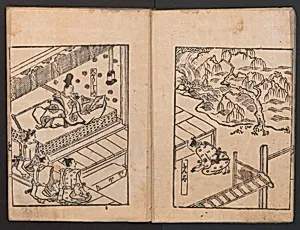
Medium
Set of two woodblock printed books; ink on paper
Dimensions
Each: 8 3/4 × 6 1/8 × 1/8 in. (22.2 × 15.6 × 0.3 cm)
Classification
Illustrated Books
Culture & Period
Japan · Edo period (1615–1868)
Department
Asian Art
Museum
Metropolitan Museum of Art, New York, NY
Credit
The Howard Mansfield Collection, Gift of Howard Mansfield, 1936
Accession Number
JIB122a, b
Rights
Public Domain
Tags
Art Historical Context
Hishikawa Moronobu *The Tale of Bunsh (Bunshō monari)*, created around 1685, is a set of two woodblock-printed books from Japan's Edo period (1615–1868). Measuring a compact 8¾ × 6⅛ inches each, these ink-on-paper volumes exemplify early ukiyo-e, the "pictures of the floating world" that celebrated everyday life, theater, and popular tales. Moronobu, often hailed as the first master ukiyo-e illustration, brought dynamic energy to his figures through fluid lines and expressive poses, making this work a cornerstone of the genre's development in book form (ehon). The story of Bunshō likely draws from folk narratives popular in urban Edo (modern Tokyo), focusing on male protagonists amid tales of adventure or romance—evident in the artwork's tag for "Men." Moronobu's precise carving techniques on woodblocks allowed for mass production, democratizing art for a growing merchant class. His attention to intricate kimono patterns and theatrical gestures reflects the vibrant kabuki culture of the time. Housed in the Metropolitan Museum of Art's Asian Art Department as part of the Howard Mansfield Collection, this pair offers a window into 17th-century Japan's cultural pulse, blending storytelling with innovative printmaking that paved the way for later luminaries like Hokusai. A delightful glimpse into an artistic revolution!
About the Artist
Hishikawa Moronobu 菱川師宣 (Japanese) · 1618 –1694
Japanese, 1618–1694