
The Tempest
carved before 1910
Medium
Marble
Dimensions
Overall (confirmed): 13 5/8 x 14 7/8 x 7 3/4 in., 73lb. (34.6 x 37.8 x 19.7 cm, 33.1126kg); Footprint of sculpture (confirmed): 14 1/2 x 6 1/2 in. (36.8 x 16.5 cm); Length of rod mount: 2 9/16 in. (6.5 cm)
Classification
Sculpture
Culture
French
Department
European Sculpture and Decorative Arts
Museum
Metropolitan Museum of Art, New York, NY
Credit
Gift of Thomas F. Ryan, 1910
Accession Number
11.173.7
Rights
Public Domain
Tags
Art Historical Context
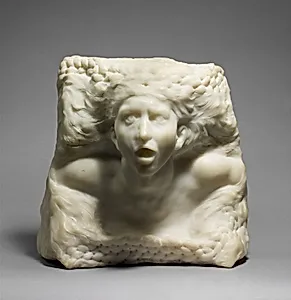
Auguste Rodin's *The Tempest*, carved in marble before 1910 captures the raw emotional intensity for which the French sculptor is renowned. at 13⅝ × 14⅞ × 7¾ inches and weighing 73 pounds, this compact yet powerful sculpture belongs to the Metropolitan Museum of Art's European Sculpture and Decorative collection, gifted by Thomas F. Ryan in1910. Rodin, a pioneer of modern sculpture associated with Impressionist influences, often drew from literary and mythological themes; the title evokes stormy passion, hinted at through its focus on expressive female faces, as suggested by its tags. Marble, a medium rooted in classical antiquity, takes on revolutionary life in Rodin's hands. He rejected polished perfection for textured, unfinished surfaces that mimic the flux of nature and human emotion, making *The Tempest* a bridge between tradition and modernism. This technique allowed him to convey movement and turmoil in static stone, aligning with his broader oeuvre like *The Thinker* or *The Gates of Hell*. Acquired early in Rodin's posthumous American acclaim, the work highlights his global impact. Visitors to the Met can appreciate how *The Tempest* embodies the sculptor's belief in art's power to reveal the soul's hidden tempests, inviting contemplation of beauty amid chaos.
About the Artist
Auguste Rodin · 1840–1917
François Auguste René Rodin (1840-1917) stands as the founder of modern sculpture, transforming the art form from academic tradition into expressive modernism. Born into a working-class Parisian family, Rodin faced early rejection, failing three times to gain admission to the prestigious École des Beaux-Arts. This setback forced him to work as a craftsman for nearly two decades, though his 1875 tr...