
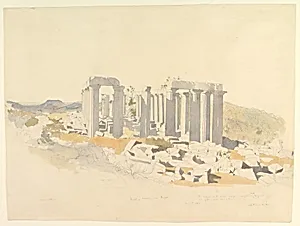
The Temple of Apollo at Bassae
Medium
Watercolor over graphite
Dimensions
15-3/4 x 21-1/8 in. (40 x 53.7 cm)
Classification
Drawings
Department
Drawings and Prints
Museum
Metropolitan Museum of Art, New York, NY
Credit
Rogers Fund, 1972
Accession Number
1972.92.5
Rights
Public Domain
Tags
Art Historical Context
Thomas Hartley Cromek’s1843 watercolor captures the Temple of Apollo atae, an ancient Greek nestled in the Arcadian mountains. Created during the height of European interest in classical antiquity, the work reflects the era’s fascination with ruins as symbols of both grandeur and transience. Cromek, a British artist who traveled extensively through Italy and Greece, recorded these sites with careful attention to architectural detail and the surrounding landscape. Executed in watercolor over graphite, the medium allowed Cromek to combine precise linear structure with luminous washes that evoke the play of Mediterranean light across weathered stone. The resulting image highlights the temple’s isolated Doric columns and rugged setting, inviting viewers to contemplate the enduring presence of antiquity amid nature’s quiet reclamation. Acquired by the Metropolitan Museum of Art through the Rogers Fund in 1972, this drawing offers today’s visitors a vivid nineteenth-century perspective on one of Greece’s most atmospheric archaeological treasures.