
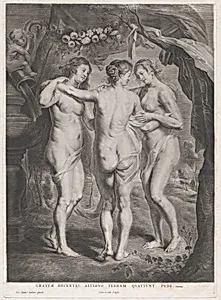
The Three Graces
ca. 1630–45
Medium
Etching and engraving; second state of two (Hollstein)
Dimensions
Plate: 19 3/16 × 13 3/4 in. (48.7 × 34.9 cm) Sheet: 19 1/4 × 21 3/4 in. (48.9 × 55.2 cm)
Classification
Prints
Department
Drawings and Prints
Museum
Metropolitan Museum of Art, New York, NY
Credit
Harris Brisbane Dick Fund, 1947
Accession Number
47.100.986
Rights
Public Domain
Art Historical Context
Behold *The Three Graces*, captivating etching and engraving by Pieter de Jode after a design by the Baroque master Peter Paul Rubens, around 1630–45. This second-state impression captures Rubens' exuberant vision of the classical mythological trio—Aglaia, Euphrosyne, and Thalia—goddesses embodying beauty, joy, and charm. Often depicted entwined in a dance, the Graces were a favorite Renaissance and Baroque motif, symbolizing harmony and the gifts of the muses, and Rubens infused them with his signature sensuality and vitality. De Jode, a skilled Flemish engraver, masterfully translated Rubens' oil painting or drawing into print form using etching for fluid, spontaneous lines and engraving for precise, intricate details. This reproductive technique was revolutionary in the 17th century, allowing Rubens' grand compositions—typically reserved for elite patrons—to reach a broader audience across Europe through affordable prints. Measuring nearly 20 by 14 inches on the plate, this work exemplifies the technical prowess of the Antwerp school, where Rubens collaborated with engravers to amplify his influence. Housed in the Metropolitan Museum of Art's Drawings and Prints department, acquired via the Harris Brisbane Dick Fund in 1947, *The Three Graces* invites visitors to marvel at Baroque splendor preserved in ink and copper. It's a testament to how prints democratized art, blending classical antiquity with 17th-century dynamism.