
The Times
Medium
Etching
Dimensions
Sheet: 12 15/16 × 16 15/16 in. (32.9 × 43 cm)
Classification
Prints
Department
Drawings and Prints
Museum
Metropolitan Museum of Art, New York, NY
Credit
The Elisha Whittelsey Collection, The Elisha Whittelsey Fund, 1959
Accession Number
59.533.18(a)
Rights
Public Domain
Tags
Art Historical Context
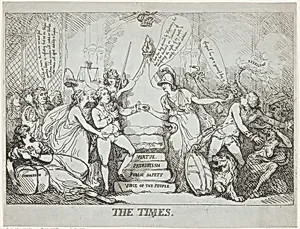
**The Times** is a lively etching by renowned British caricaturist Thomas Rowlandson published by S.W.ores in December 178. Measuring 12 15/16 × 16 15/16 inches, this hand-pulled print from the Metropolitan Museum of Art's Drawings and Prints department buzzes with satirical energy, poking fun at politics, men, and women amid Britain's chaotic late-Georgian era. Rowlandson's loose, expressive lines capture exaggerated figures in absurd scenarios, a hallmark of his caricatural style that made high-society follies accessible to everyday viewers. Created during the Regency crisis—when King George III's mental illness sidelined him and elevated his playboy son, George, Prince of Wales, as a potential regent—the artwork skewers the "times" with biting commentary on power grabs, scandals, and social hypocrisies. Etching's precision allowed for intricate details and affordable reproduction, fueling the explosion of political satire in 18th-century London print shops. This piece highlights satire's cultural punch: it didn't just entertain but shaped public discourse, mocking elites while delighting the masses. Part of The Elisha Whittelsey Collection, **The Times** invites us to laugh at history's absurdities, reminding visitors how art has long held a mirror to society's wild underbelly.
About the Artist
Thomas Rowlandson|George, Prince of Wales|S. W. Fores · 1756–1827
Thomas Rowlandson (1757–1827) was an English artist and caricaturist whose satirical watercolors and prints captured the social life of Georgian Britain with unparalleled wit and technical mastery. Alongside James Gillray, he is recognized as one of the greatest British graphic artists, and his distinctive flowing line and keen observations have made his work integral to understanding late 18th an...