
The Tiny Pool
[1879]
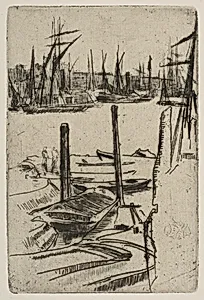
Medium
Etching and drypoint, printed in black ink on ivory laid paper; third state of three (Glasgow)
Dimensions
Plate: 3 7/8 × 2 9/16 in. (9.8 × 6.5 cm) Sheet: 8 in. × 6 5/16 in. (20.3 × 16.1 cm)
Classification
Prints
Department
Drawings and Prints
Museum
Metropolitan Museum of Art, New York, NY
Credit
Harris Brisbane Dick Fund, 1917
Accession Number
17.3.76
Rights
Public Domain
Tags
Art Historical Context
James McNeill Whistler’s *The Tiny Pool* (1879) captures the intimate tranquility of Venice’s hidden waterways, a motif from the artist’s transformative visit to the city that year. Exiled from London after a high-profile libel trial, Whistler arrived in Venice with limited resources, producing around 50 groundbreaking etchings that revitalized his career. This small-scale print, featuring boats gently nestled in a narrow canal, exemplifies his shift toward subtle, atmospheric compositions inspired by Japanese prints and the Aesthetic movement’s mantra of “art for art’s sake.” Printed in black ink on ivory laid paper, the work combines etching—where acid bites precise lines into a metal plate—with drypoint, Whistler’s signature technique of scratching directly into the plate for velvety, burr-rich textures. This third (and final) state from the Glasgow catalog reveals his meticulous refinement, enhancing tonal depth and evoking misty reflections. At just under 4 by 2.5 inches, its miniature format invites close contemplation, a hallmark of Whistler’s innovative printmaking that influenced modern artists like Edgar Degas. Acquired through the Harris Brisbane Dick Fund in 1917, *The Tiny Pool* resides in the Metropolitan Museum of Art’s Drawings and Prints department. It stands as a testament to Whistler’s mastery in distilling Venice’s poetic essence into enduring, jewel-like images.
About the Artist
James McNeill Whistler · 1834–1903
James Abbott McNeill Whistler (1834-1903) was an American-born painter and printmaker who became a leading figure in the Aesthetic Movement and pioneer of Tonalism and Japonisme. He revolutionized art by championing "art for art's sake" and treating paintings as visual equivalents of musical compositions, titling works as "arrangements," "harmonies," and "nocturnes" to emphasize formal qualities o...