
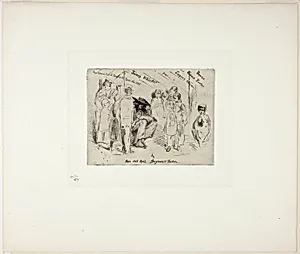
The Title Page for 'Douze Eaux Fortes d'après Nature'
Medium
Etching with foul biting in black ink on off-white China paper laid down on off-white wove paper (chine collé)
Dimensions
Plate: 11.1 × 14.7 cm (4 3/8 × 5 13/16 in.); Sheet: 28.8 × 34 cm (11 3/8 × 13 7/16 in.)
Classification
etching
Department
Prints and Drawings
Museum
Art Institute of Chicago
Accession Number
20033
Rights
Public Domain
Art Historical Context
Step into the refined world of James McNeillistler with *The Title Page for 'Douze Eaux Fortes d'après Nature'* (1858), a delicate etching that serves as the elegant introduction to his groundbreaking series of twelve prints. Created early in Whistler's career when the American-born artist was immersed in the vibrant art scenes of Paris and London, work captures his emerging mastery of printmaking. Whistler, a pioneer of Aestheticism who later championed "art for art's sake," drew inspiration from 17th-century masters like Rembrandt while pushing boundaries with realist depictions "from nature." The technique shines here: etched in black ink on thin off-white China paper, then laid down on sturdy wove paper via *chine collé*—a method that allowed for intricate lines and subtle tones on delicate supports. Notice the "foul biting," where acid unintentionally corroded the plate, adding gritty, textured effects that enhance the organic feel. Measuring a modest plate size of 11.1 × 14.7 cm, this title page exemplifies Whistler's innovative approach to etching, blending precision with serendipity. Housed in the Art Institute of Chicago's Prints and Drawings department, this piece highlights Whistler's pivotal 1858 series, which revolutionized etching by emphasizing atmospheric subtlety over mere reproduction. It's a window into his evolution from realist roots toward the impressionistic harmonies that defined his legacy.
About the Artist
James McNeill Whistler · 1834–1903
James Abbott McNeill Whistler (1834-1903) was an American-born painter and printmaker who became a leading figure in the Aesthetic Movement and pioneer of Tonalism and Japonisme. He revolutionized art by championing "art for art's sake" and treating paintings as visual equivalents of musical compositions, titling works as "arrangements," "harmonies," and "nocturnes" to emphasize formal qualities o...