
The Toilet
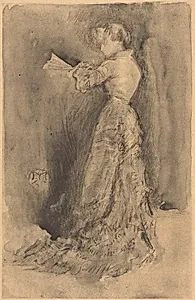
Medium
lithotint in black on wove paper
Dimensions
image: 26 × 16.4 cm (10 1/4 × 6 7/16 in.) sheet: 38.2 × 26.3 cm (15 1/16 × 10 3/8 in.)
Classification
Department
CG-W
Museum
National Gallery of Art, Washington, D.C.
Credit
Rosenwald Collection
Accession Number
1943.3.8665
Rights
Public Domain
Art Historical Context
James McNeill Whistler's *The Toilet* (1878) invites visitors into an intimate domestic moment, rendered with exquisite subtlety in lithotint—a specialized lithography technique using tusche to create soft, painterly tonal gradations on wove paper. Measuring just 26 × 16.4 cm, this black-and-white print captures the artist's mastery of light and shadow, evoking hushed, private ritual of grooming that feels both timeless and modern. Whistler, an American expatriate in London and a leader of the Aesthetic movement, championed "art for art's sake," prioritizing harmony and tone over narrative detail. His prints from the late 1870s, including this one, pushed printmaking toward the fluidity of etching and painting, challenging the era's rigid academic traditions. Lithotint's velvety textures mimic oil sketches, making *The Toilet* a bridge between his famous Nocturnes and exploratory graphic works. Housed in the National Gallery of Art's Rosenwald Collection, this piece highlights Whistler's innovative spirit amid his battles with critics—like his infamous 1878 libel trial against John Ruskin. For museumgoers, it offers a window into Victorian private life reimagined through Aesthetic beauty, where subtlety reigns supreme.
About the Artist
James McNeill Whistler · 1834–1903
James Abbott McNeill Whistler (1834-1903) was an American-born painter and printmaker who became a leading figure in the Aesthetic Movement and pioneer of Tonalism and Japonisme. He revolutionized art by championing "art for art's sake" and treating paintings as visual equivalents of musical compositions, titling works as "arrangements," "harmonies," and "nocturnes" to emphasize formal qualities o...