
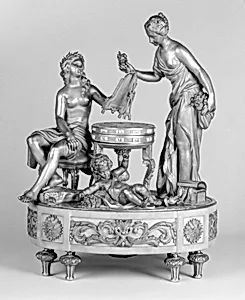
The Toilette of Venus
last quarter 18th century
Medium
Case: gilded bronze and marble; Dial: gilded bronze and white enamel; Movement: brass and steel
Dimensions
Overall: 19 3/8 × 14 × 10 1/2 in. (49.2 × 35.6 × 26.7 cm)
Classification
Horology
Culture
French, Paris
Department
European Sculpture and Decorative Arts
Museum
Metropolitan Museum of Art, New York, NY
Credit
Gift of Edith C. Blum, (et al.) Executors, in memory of Mr. and Mrs. Albert Blum, 1966
Accession Number
66.28.2
Rights
Public Domain
Tags
Art Historical Context
Step into the opulent world of 18th-century French decorative arts with *The Toilette of Venus*, a exquisite clock crafted by renowned sculptor Étienne-Maurice Falconet in the last quarter of the. Falconet, a master of Rococo sculpture celebrated for his graceful, playful forms, transformed this functional timepiece into a mythological tableau. Depicting the goddess Venus at her toilette attended by the mischievous Cupid, the work embodies the era's fascination with classical antiquity reimagined through lavish luxury. Housed in a case of gilded bronze and veined marble, with a dial of gilded bronze and white enamel, and an intricate brass-and-steel movement, the clock measures an impressive 19⅜ × 14 × 10½ inches. The shimmering gilding and fine enameling highlight Rococo's signature exuberance—delicate curves, floral motifs, and sensual figures that evoke the salons of Parisian aristocracy. Such horological masterpieces were status symbols for the elite, blending artistry with precision engineering. A gift to the Metropolitan Museum of Art in 1966, this piece from the European Sculpture and Decorative Arts collection captures the cultural zenith of pre-Revolutionary France, where myth and mechanics merged to celebrate beauty and time's fleeting grace. Visitors, admire how Falconet's sculptural finesse elevates everyday utility into enduring elegance.