
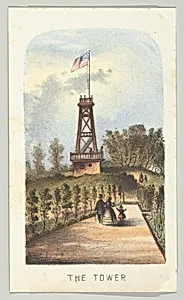
The Tower, from the series, Views in Central Park, New York, Part 2
Medium
Color lithograph
Dimensions
Sheet: 4 in. × 2 3/8 in. (10.2 × 6.1 cm)
Classification
Prints|Ephemera
Department
Drawings and Prints
Museum
Metropolitan Museum of Art, New York, NY
Credit
The Jefferson R. Burdick Collection, Gift of Jefferson R. Burdick, 1947
Accession Number
47.91.25(36)
Rights
Public Domain
Tags
Art Historical Context
Step into the bustling heart of 19th-century New York *The Tower, from the series, Views Central Park, New York, Part 2*, a delicate color lithograph produced by Louis Prang & Co in 1864. This petite print (just 4 × 2⅜ inches) captures a striking tower adorned with flags, likely one of Central Park's early structures amid its nascent landscapes. Prang, a German-born innovator who established his Boston firm in the 1860s, specialized in chromolithography—a revolutionary technique layering colored inks to mimic paintings with vibrant precision and affordability. Created during the Civil War era, when Central Park had only opened in 1858 as Manhattan's first major public green space, this image reflects urban America's growing embrace of leisure and nature amid national turmoil. Flags fluttering atop the tower evoke patriotism and festivity, offering visitors a pocket-sized souvenir of the park's allure. As ephemera from The Metropolitan Museum of Art's Jefferson R. Burdick Collection, it highlights chromolithography's role in democratizing art. Prang's mastery made such scenic views accessible to middle-class homes, preserving fleeting moments of Gilded Age optimism in vivid color. A charming glimpse into a transforming city!
About the Artist
Louis Prang & Co. · 1800–1950
Louis Prang & Co. was the Boston printing firm that introduced the Christmas card to the American public and elevated chromolithography to the level of a serious art form. Its founder, Louis Prang (1824–1909), was born in Breslau, Prussia (now Wrocław, Poland), where he trained as a cloth printer and dyer. After participating in revolutionary activity against the Prussian government, he fled first...