
The Towing-Path
1826 to 1850
Medium
etching on laid paper
Dimensions
overall (trimmed to plate): 4.8 × 8.3 cm (1 7/8 × 3 1/4 in.)
Classification
Department
CG-W
Museum
National Gallery of Art, Washington, D.C.
Credit
Rosenwald Collection
Accession Number
1943.3.8572
Rights
Public Domain
Art Historical Context
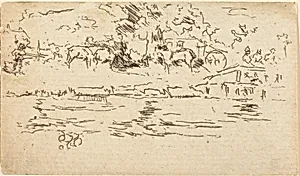
James McNeill Whistler’s *The Towing-Path* is a delicate etching on laid paper, measuring just 4.8 × 8.3 cm, capturing the quiet poetry of 19th-century English river life. Created between 1826 and 1850, this intimate print likely depicts a scene along a canal or river towing path, where horses or workers pulled barges—a common sight in industrializing Britain. Whistler, an American-born artist who became a key figure in the Aesthetic movement, mastered etching to evoke subtle atmospheres rather than literal detail, blending Realism with impressionistic subtlety. Whistler’s etching technique shines here: using soft-ground etching on laid paper, he achieved velvety lines and tonal gradations that suggest mist, water, and distant figures without overworking the plate. This small-scale work exemplifies his early experiments with printmaking, prioritizing harmony and mood—hallmarks of his philosophy that art should be "art for art’s sake." Trimmed to the plate edge, it invites close viewing, rewarding the observer with its refined craftsmanship. Housed in the National Gallery of Art’s Rosenwald Collection (Department CG-W), *The Towing-Path* highlights Whistler’s influence on modern printmaking. For visitors, it’s a window into Victorian waterways, reminding us how everyday labor inspired timeless beauty in art.
About the Artist
James McNeill Whistler · 1834–1903
James Abbott McNeill Whistler (1834-1903) was an American-born painter and printmaker who became a leading figure in the Aesthetic Movement and pioneer of Tonalism and Japonisme. He revolutionized art by championing "art for art's sake" and treating paintings as visual equivalents of musical compositions, titling works as "arrangements," "harmonies," and "nocturnes" to emphasize formal qualities o...