
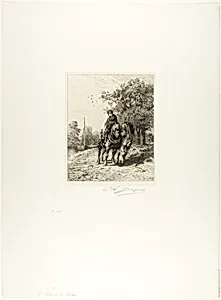
The Towpath
c. 1864
Medium
Etching on light gray China paper laid down on ivory wove paper
Dimensions
Image: 15.3 × 12.4 cm (6 1/16 × 4 15/16 in.); Chine: 16.4 × 13.2 cm (6 1/2 × 5 1/4 in.); Plate: 21.5 × 17.4 cm (8 1/2 × 6 7/8 in.); Sheet: 31.2 × 42.3 cm (12 5/16 × 16 11/16 in.)
Classification
etching
Department
Prints and Drawings
Museum
Art Institute of Chicago
Accession Number
45802
Rights
Public Domain
Art Historical Context
**The Towpath** by Charles Émile Jac, created around 1864, captures the quiet rhythm 19th-century rural France Jacque, a prominent member of the Barbizon School artists like Jean-François Millet and Théodore Rousseau, specialized in realistic depictions of countryside life, often featuring animals and laborers. This etching likely portrays a towpath along a canal or riverbank—a vital artery for transporting goods before widespread railroads—evoking the harmonious bond between humans, beasts of burden, and nature in an era of industrial change. Printed as an etching on delicate light gray China paper, then laid down on sturdy ivory wove paper, the work showcases Jacque's mastery of intaglio techniques. Etching allowed him to incise fine lines into a metal plate with acid, producing rich tonal contrasts and intricate textures that mimic the softness of pencil sketches. The modest image size (15.3 × 12.4 cm) belies its detail, with the China paper enhancing subtle gradations ideal for capturing misty landscapes and weathered paths. Housed in the Art Institute of Chicago's Prints and Drawings department, **The Towpath** exemplifies the 19th-century print revival, making fine art accessible beyond paintings. Jacque's oeuvre, blending Romantic nostalgia with Realist precision, invites us to pause and appreciate the unsung beauty of everyday toil. (198 words)