
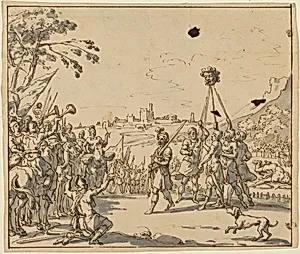
The Triumph of David
c. 1700
Medium
pen and brown ink with gray wash on laid paper
Dimensions
overall (approximate): 15.7 x 18.5 cm (6 3/16 x 7 5/16 in.)
Classification
Drawing
Department
CG-E
Museum
National Gallery of Art, Washington, D.C.
Credit
Gift of Leonard Baskin
Accession Number
1971.14.1
Rights
Public Domain
Art Historical Context
This delicate drawing, created around 1700 in the style of Dutch artist Jan Luyken, captures the triumphant return of the biblical hero David after his victory over Goliath. Luyken, a prolific engraver and illustrator renowned for his vivid religious and historical scenes, often produced such works for books and prints that brought scripture to life for 17th- and 18th-century audiences. The compact composition, measuring just over 6 by 7 inches, likely served as a preparatory study or design for an engraving, reflecting the era’s deep interest in moral and devotional imagery. Executed in pen and brown ink with gray wash on laid paper, the work demonstrates the expressive potential of these fluid media. Luyken’s followers used varying ink tones and subtle washes to create depth, movement, and dramatic contrast, guiding the viewer’s eye through the celebratory procession. The small scale invites intimate viewing, highlighting fine details such as the figures’ gestures and flowing drapery. Now part of the National Gallery of Art’s collection through the generosity of Leonard Baskin, this drawing offers a window into the rich tradition of Dutch biblical illustration at the turn of the 18th century. It reminds us how artists of the period blended storytelling, faith, and technical skill to make ancient narratives feel immediate and inspiring.