
The Triumph of David
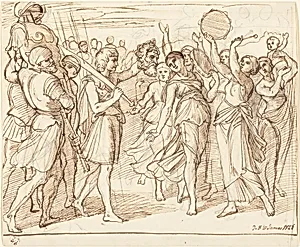
Medium
pen and brown ink over graphite on wove paper
Dimensions
sheet: 22.6 x 27.1 cm (8 7/8 x 10 11/16 in.)
Classification
Drawing
Department
CG-E
Museum
National Gallery of Art, Washington, D.C.
Credit
Ailsa Mellon Bruce Fund
Accession Number
1996.26.1
Rights
Public Domain
Art Historical Context
Julius Schnorr von Carolsfeld’s *The Triumph of David* (1826) captures a pivotal biblical moment with quiet drama. The drawing shows the young hero returning from battle, likely bearing Goliath’s head, as onlookers celebrate his victory. Created during the artist’s time in Rome, the work reflects his deep engagement with religious narrative and his desire to revive the moral clarity of early Renaissance art. Schnorr belonged to the Nazarene movement, a circle of German artists who rejected neoclassical polish in favor of precise line, luminous detail, and spiritual sincerity inspired by Dürer and Raphael. This sheet, executed in pen and brown ink over graphite, demonstrates the meticulous draftsmanship the Nazarenes prized; the layered media allow for both delicate modeling and crisp contours that give the figures a sculptural presence despite the modest size. Acquired by the National Gallery of Art through the Ailsa Mellon Bruce Fund, the drawing offers today’s viewers an intimate glimpse into the preparatory process of a leading nineteenth-century history painter and the enduring appeal of the David story as a symbol of courage and faith.
About the Artist
Julius Schnorr von Carolsfeld · 1794–1872
German, Leipzig 1794–1872 Dresden