
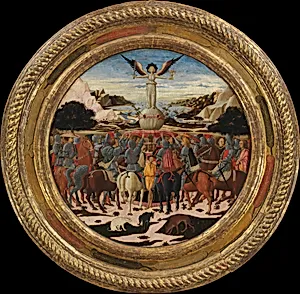
The Triumph of Fame; (reverse) Impresa of the Medici Family and Arms of the Medici and Tornabuoni Families
Medium
Tempera, silver, and gold on wood
Dimensions
Overall, with engaged frame, diameter 36 1/2 in. (92.7 cm); recto, painted surface, diameter 24 5/8 in. (62.5 cm); verso, painted surface, diameter 29 5/8 in. (75.2 cm)
Classification
Paintings
Department
European Paintings
Museum
Metropolitan Museum of Art, New York, NY
Credit
Purchase in memory of Sir John Pope-Hennessy: Rogers Fund, The Annenberg Foundation, Drue Heinz Foundation, Annette de la Renta, Mr. and Mrs. Frank E. Richardson, and The Vincent Astor Foundation Gifts, Wrightsman and Gwynne Andrews Funds, special funds, and Gift of the children of Mrs. Harry Payne Whitney, Gift of Mr. and Mrs. Joshua Logan, and other gifts and bequests, by exchange, 1995
Accession Number
1995.7
Rights
Public Domain
Tags
Art Historical Context
Step into the radiant world of Renaissance Florence with *The Triumph of Fame*, magnificent double-sided tondo created around 1449 by Giovanni di ser Giovannii, known as Scheggia. This circular panel, measuring over 36 inches in diameter its ornate frame, showcases Scheggia's mastery of tempera, silver, and gold on wood—a luxurious technique that evokes the opulence of 15th-century Italian courts. The recto bursts with a dynamic procession of armored men, horses, dogs, and animals, symbolizing Fame's victorious parade, likely inspired by Petrarch's poetic *Trionfi*, a Renaissance favorite celebrating human glory. The verso reveals its noble patronage: the *Impresa* of the Medici family alongside the arms of the Medici and Tornabuoni lineages. As Florence's preeminent bankers and art patrons, the Medici commissioned such works for weddings, births, or civic displays, blending heraldry with allegory to assert power and legacy. Scheggia's intricate detailing in gold and silver heightens the festive, almost theatrical quality, typical of Florentine *deschi da parto* (birth trays) or cassone panels. Housed in the Metropolitan Museum of Art's European Paintings department, this artwork captures the era's humanist spirit, where art glorified the elite while dazzling viewers with technical brilliance. A true gem of early Renaissance narrative painting!