
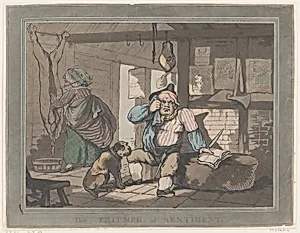
The Triumph of Sentiment
January 15, 1787
Medium
Hand-colored etching and aquatint
Dimensions
Sheet: 12 1/2 in. × 16 in. (31.8 × 40.7 cm)
Classification
Prints
Department
Drawings and Prints
Museum
Metropolitan Museum of Art, New York, NY
Credit
The Elisha Whittelsey Collection, The Elisha Whittelsey Fund, 1959
Accession Number
59.533.216
Rights
Public Domain
Tags
Art Historical Context
Created in 1787 by the collaborative efforts of Thomas Rowlandson, Samuel Collings, and publisher Elizabeth Jackson, *The Triumph of Sentiment* is a hand-colored etching and aquatint that captures the lively spirit of late eighteenth-century British printmaking. Rowlandson, renowned for his witty caricatures, often worked with other artists and colorists to produce affordable, vividly tinted prints that reached a broad audience. The medium allowed for sharp lines and delicate tonal effects, while hand-coloring added a playful, personal touch that made each impression feel unique. This satirical work reflects the era’s fascination with “sentiment,” a cultural ideal celebrating emotional sensitivity and moral feeling. Set against the backdrop of Enlightenment debates and shifting social norms, the print likely pokes gentle fun at fashionable displays of emotion through its lively cast of figures, dogs, and symbolic elements. Today it offers visitors a charming window into Georgian humor and the vibrant world of London’s print shops, where art and social commentary met on equal terms.
About the Artist
Thomas Rowlandson|Samuel Collings|Elizabeth Jackson · 1756–1827
Thomas Rowlandson (1757–1827) was an English artist and caricaturist whose satirical watercolors and prints captured the social life of Georgian Britain with unparalleled wit and technical mastery. Alongside James Gillray, he is recognized as one of the greatest British graphic artists, and his distinctive flowing line and keen observations have made his work integral to understanding late 18th an...