
The Trough
1864
Medium
Etching
Dimensions
Sheet: 10 1/8 × 13 1/16 in. (25.8 × 33.3 cm) Plate: 5 1/2 × 8 1/4 in. (14 × 21 cm)
Classification
Prints
Department
Drawings and Prints
Museum
Metropolitan Museum of Art, New York, NY
Credit
Harris Brisbane Dick Fund, 1927
Accession Number
27.10.50
Rights
Public Domain
Tags
Art Historical Context
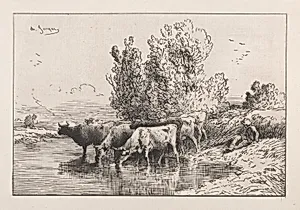
**The Trough** (1864) by Charlesque captures the quiet rhythm of rural life, a hallmark of the French Barbizon school. Jacque, a 19th-century painter andmaker, specialized in pastoral scenes featuring farm animals, drawing inspiration from the natural landscapes around Barbizon village. Created during a time when Realism was challenging idealized Romanticism, this etching reflects the movement's emphasis on everyday peasant and the harmony between humans, animals, and nature—much like works by contemporaries Jean-François Millet and Théodore Rousseau. As an etching, the work showcases Jacque's mastery of intaglio printmaking, where a copper plate is incised with acid to create fine, expressive lines. The modest plate size (5½ × 8¼ in.) allowed for intricate detailing of textures, from the cows' coarse hides to the wooden trough's grain, while the larger sheet (10⅛ × 13¹/₁₆ in.) provides a subtle frame of white space. Etchings like this were prized for their reproducibility, making high-quality art accessible beyond paintings. Housed in The Metropolitan Museum of Art's Drawings and Prints department (Harris Brisbane Dick Fund, 1927), **The Trough** invites visitors to pause amid the cows' gentle gathering, evoking 19th-century France's agrarian soul. It's a testament to Jacque's affection for humble barnyard moments, blending technical precision with poetic simplicity.
About the Artist
Charles Jacque · 1813–1894
Charles-Émile Jacque (1813–1894) was a pioneering French painter, engraver, and illustrator whose career bridged the worlds of printmaking and pastoral painting. Born in Paris amid a difficult childhood, he apprenticed at age seventeen to a map engraver, mastering drypoint technique and producing his first etching in 1830—a copy of a head after Rembrandt. After serving seven years in the French Ar...