
The Tyresmith
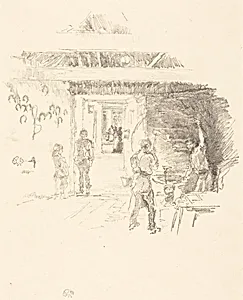
Medium
lithograph in black on wove paper
Dimensions
image: 17 × 17.5 cm (6 11/16 × 6 7/8 in.) sheet: 28.8 × 22.1 cm (11 5/16 × 8 11/16 in.)
Classification
Department
CG-W
Museum
National Gallery of Art, Washington, D.C.
Credit
Rosenwald Collection
Accession Number
1943.3.8687
Rights
Public Domain
Art Historical Context
James McNeill Whistler’s *The Tyresmith* (1890) is a striking lithograph in black ink on wove paper, the essence of everyday labor with the artist’s signature subtlety. Measuring just 17 × 17.5 cm in its image area, this intimate print belongs to the National Gallery of Art’s Rosenwald Collection Whistler, the American-born painter and printmaker renowned for his Aesthetic movement ideals—“art for art’s sake”—turned to lithography in the 1880s and 1890s, producing over 100 works that showcased his fluid line work and tonal mastery. Lithography allowed Whistler to draw spontaneously directly onto the stone, translating his delicate, impressionistic touch into prints that rivaled his paintings in atmospheric depth. *The Tyresmith* likely evokes the gritty poetry of a craftsman at work—hammering and shaping metal—rendered in velvety blacks and subtle grays that emphasize form and shadow over narrative detail. This technique highlighted Whistler’s innovative approach, bridging fine art and printmaking during a period when such media gained prestige. As part of Whistler’s later Venice and London series, the piece reflects fin-de-siècle fascination with urban toil amid industrialization, inviting viewers to appreciate beauty in the mundane. A gem for print enthusiasts, it underscores his enduring influence on modern graphic arts.
About the Artist
James McNeill Whistler · 1834–1903
James Abbott McNeill Whistler (1834-1903) was an American-born painter and printmaker who became a leading figure in the Aesthetic Movement and pioneer of Tonalism and Japonisme. He revolutionized art by championing "art for art's sake" and treating paintings as visual equivalents of musical compositions, titling works as "arrangements," "harmonies," and "nocturnes" to emphasize formal qualities o...