
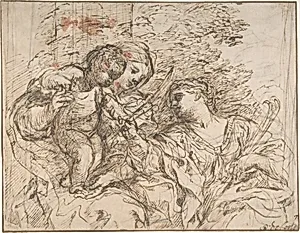
The Virgin and Child with Saint Martina
Medium
Pen and brown ink, brush and brown wash, over black chalk; framing lines in pen and brown ink
Dimensions
9 5/8 x 12 3/8in. (24.5 x 31.5cm)
Classification
Drawings
Department
Drawings and Prints
Museum
Metropolitan Museum of Art, New York, NY
Credit
Bequest of Benjamin Sonnenberg, 1978
Accession Number
1979.3
Rights
Public Domain
Tags
Art Historical Context
Welcome to the Metropolitan Museum of's Drawings and Prints collection, where Pietro da Cortona's *The Virgin and Child with Saint Martina* (ca. 17th century) captivates with its tender spirituality. This exquisite preparatory drawing, measuring 9⅝ × 12⅜ inches, showcases the Virgin Mary cradling the Christ Child while gazing toward Saint Martina, a Roman martyr venerated for her faith during early Christian persecutions. Such Madonna and Child compositions with saints were central to Baroque religious art, evoking devotion amid the Counter-Reformation's emphasis on emotional piety. Crafted in pen and brown ink with brush and brown wash over black chalk—framed by delicate ink lines—Cortona's technique reveals his mastery as a leading Roman Baroque artist (1596–1669). The underdrawing in black chalk provides subtle modeling, while fluid ink strokes and translucent washes build depth and luminosity, hallmarks of his dynamic style influenced by the Carracci and classical antiquity. These mixed-media drawings often served as studies for grand frescoes or altarpieces, bridging sketch and finished work. Bequeathed by Benjamin Sonnenberg in 1978, this piece highlights Cortona's role in transforming Italian art with theatrical grace and humanism, inviting us to ponder the intimate bond between divine figures and the faithful. A gem for lovers of 17th-century draftsmanship!
About the Artist
Pietro da Cortona (Pietro Berrettini) · 1596–1669
Pietro da Cortona, born Pietro Berrettini on November 1, 1596, in the Tuscan hill town of Cortona, emerged as one of the towering figures of Italian Baroque art, excelling as a painter, architect, and decorator. He received his early training under the Florentine painters Andrea Commodi and Baccio Ciarpi. In 1612, Commodi brought the young artist to Rome, where Pietro immersed himself in the city'...