
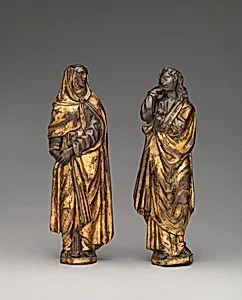
The Virgin Mary
late 15th century
Medium
Bronze, partially fire-gilt
Dimensions
Overall (confirmed): 7 5/8 × 2 1/2 × 1 9/16 in. (19.4 × 6.4 × 4 cm); Height (base): 3 3/16 in. (8.1 cm)
Classification
Sculpture-Bronze
Culture
Italian, Siena
Department
European Sculpture and Decorative Arts
Museum
Metropolitan Museum of Art, New York, NY
Credit
Rogers Fund, 1960
Accession Number
60.37.1
Rights
Public Domain
Tags
Art Historical Context
Neroccio de’ Landi, a leading artist of Renaissance Siena, created this intimate bronze statuette of the Virgin Mary in the late fifteenth century. Working in a city renowned for its rich tradition of goldsmithing and devotional art, Neroccio brought his painter’s sensitivity to sculptural form, softening the figure’s drapery and lending the Madonna a gentle, contemplative expression typical of Sienese piety. Cast in bronze and partially fire-gilt, the sculpture glows where gold has been fused to the surface, highlighting the Virgin’s crown, halo, and the folds of her mantle. At just under eight inches tall, the piece was likely intended for private devotion, allowing its owner a personal connection to the sacred figure. Such small bronzes bridged the worlds of monumental church sculpture and the emerging taste for collectible art in Renaissance households. Today in the Metropolitan Museum, the statuette exemplifies how Sienese artists adapted new Renaissance techniques while preserving the graceful, spiritual elegance that defined their regional style.