
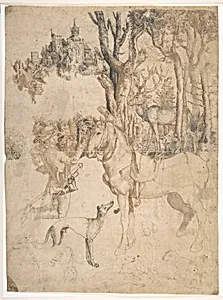
The Vision of Saint Eustace
16th century
Medium
Pen and brown and black ink, over traces of black chalk.
Dimensions
13 7/8 x 10 3/8 in. (35.2 x 26.3 cm)
Classification
Drawings
Department
Drawings and Prints
Museum
Metropolitan Museum of Art, New York, NY
Credit
Gift of Cornelius Vanderbilt, 1880
Accession Number
80.3.483
Rights
Public Domain
Tags
About this artwork
This sixteenth-century print depicts the miraculous conversion of the Roman general Placidus, who encountered a stag bearing a crucifix between its antlers while hunting. The composition shows the moment when Christ spoke through the stag, causing Placidus to fall from his horse and convert to Christianity, subsequently receiving baptism under the name Eustace. The anonymous German artist drew inspiration from Albrecht Dürer's masterful engraving of the same subject, created around 1501, which h...
Art Historical Context
Behold *The Vision of Saint Eust*, a captivating 16th-century drawing an anonymous German artist, rendered in pen and brown and black ink over traces of black chalk. work captures the legendary moment when the Roman general Placidus out hunting, encounters a majestic stag bearing a crucifix between antlers. As Christ speaks through the animal, Placidus tumbles from his horse in awe, marking his miraculous conversion to Christianity and adoption of the name Eustace Surrounded by huntsmen, dogs, horses, and a lush landscape, the scene pulses with drama and devotion. Deeply inspired by Albrecht Dürer's groundbreaking engraving of the same subject from around 1501—his largest and most virtuoso work—the drawing echoes Dürer's mastery in depicting wildlife, foliage, and rugged terrain. Dürer's innovative techniques set new standards for naturalism, influencing artists across Europe for generations. Saint Eustace, a beloved patron of hunters in medieval and Renaissance Christianity, embodied themes of sudden faith that resonated widely. Housed in the Metropolitan Museum of Art's Drawings and Prints department, this piece highlights the era's vibrant print culture, where reproductive works like this spread artistic ideas far and wide. At 13⅞ × 10⅜ inches, it invites you to trace the ripples of Dürer's genius in every intricate line.
About the Artist
Albrecht Dürer|Anonymous, German, 16th century · 1471–1528
Albrecht Dürer (1471–1528) stands as the preeminent figure of the Northern Renaissance and arguably the most influential artist in the history of printmaking. Born in Nuremberg on May 21, 1471, and dying in the same city on April 6, 1528, Dürer revolutionized the status of the artist in Northern Europe, transforming printmaking from a commercial craft into an independent fine art and establishing ...