
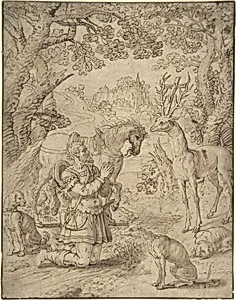
The Vision of St. Eustace
Medium
Pen and brown ink, brush and brown wash. Framing lines in pen and brown.
Dimensions
7 3/16 x 5 5/8 in. (18.3 x 14.3 cm)
Classification
Drawings
Department
Drawings and Prints
Museum
Metropolitan Museum of Art, New York, NY
Credit
The Elisha Whittelsey Collection, The Elisha Whittelsey Fund, 1950
Accession Number
50.605.5
Rights
Public Domain
Tags
Art Historical Context
In the tranquil intimacy of a 17th-century Flemish drawing, *The Vision of St. Eustace* captures a pivotal moment from Christian hagiography. Created anonymously by a Netherlandish or Flemish artist using pen and brown ink with brush and brown wash, small-scale work (7 3/16 x 5 5/8 in.) exemplifies the refined draftsmanship of Northern European workshops. The framing lines in pen and brown ink suggest it was a finished study, perhaps for a larger painting or print, highlighting the era's emphasis on preparatory sketches as standalone artworks. The scene depicts St. Eustace, a Roman general-turned-saint, amid a hunting party with deer, dogs, and horses. A radiant cross appears miraculously between a stag's antlers, symbolizing his divine conversion around 100 AD. This legend, popular in medieval and Renaissance art, inspired countless depictions, from Pisanello's famous 15th-century fresco to later Baroque visions, underscoring themes of faith triumphing over worldly pursuits. Housed in the Metropolitan Museum of Art's Drawings and Prints department as part of The Elisha Whittelsey Collection, this piece reveals the technical virtuosity of brown wash for modeling light and shadow, evoking drama in a compact format. It invites visitors to ponder how such intimate drawings bridged devotion and artistry in Flanders' Golden Age.