
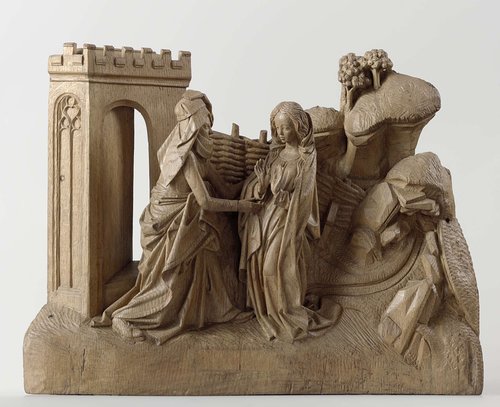
The Visitation
c. 1475 - c. 1477
Medium
oak with traces of polychromy
Dimensions
67.8; 16.5; 52
Rights
Public Domain
About this artwork
eikenhout met sporen van polychromie
Art Historical Context
**The Visitation** by Adriaen van Wes, carved around 1475–1477, captures a pivotal biblical moment: the encounter between the Virgin Mary and her cousin Elizabeth, announcing the coming births of Jesus and John the. This Netherlandish sculptor, active in Utrecht, was renowned for his intricate wooden religious figures that bridged Late Gothic traditions with emerging Renaissance naturalism. Van Wesel's work often adorned altarpieces and tabacles, emphasizing emotional depth and elegant drapery in scenes of devotion. Crafted from oak—a durable, fine-grained wood ideal for detailed carving—the sculpture bears traces of polychromy, the original colorful paints and gilding that brought it vividly to life. Standing 52 cm high, 67.8 cm wide, and 16.5 cm deep, it likely served as a relief panel in a church or private chapel, inviting worshippers to contemplate divine mystery through its textured surfaces and subtle modeling. In the late 15th-century Low Countries, such sculptures reflected a cultural fervor for religious art amid the Devotio Moderna movement, blending piety with artistic refinement. Though time has faded its hues, *The Visitation* endures as a testament to van Wesel's mastery, offering visitors a window into medieval spirituality and craftsmanship.