
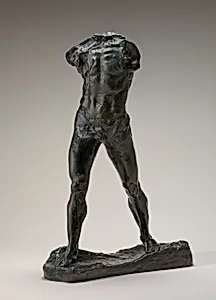
The Walking Man (L'Homme qui marche)
model 1878-1900, cast probably 1903
Medium
bronze
Dimensions
overall: 85.1 x 59.8 x 26.5 cm (33 1/2 x 23 9/16 x 10 7/16 in.)
Classification
Sculpture
Department
CSD
Museum
National Gallery of Art, Washington, D.C.
Credit
Gift of Mrs. John W. Simpson
Accession Number
1942.5.11
Rights
Public Domain
Art Historical Context
Auguste Rodin’s *The Walking Man* captures the raw power of human motion in a striking bronze form. Modeled between 1878 and 1900 and cast around 3, the sculpture depicts a headless, armless figure striding forward with intense energy. Rodin, a leading figure in modern sculpture, often explored the body in fragments to emphasize movement and vitality rather than polished perfection. This approach broke from traditional academic ideals and helped redefine sculpture for the modern era. The work reflects Rodin’s deep interest in anatomy and the expressive potential of incomplete forms. By stripping away details like the head and arms, he directs attention to the tense muscles and forward thrust of the legs, creating a sense of unstoppable momentum. Cast in bronze, the surface retains a lively, textured quality that invites viewers to sense the artist’s hand at work. As a gift to the National Gallery of Art from Mrs. John W. Simpson, *The Walking Man* stands as an enduring example of Rodin’s innovative spirit. Its modest scale—roughly 33 inches tall—makes the figure feel both monumental and intimate, encouraging visitors to consider how even a partial form can convey the full drama of life in motion.
About the Artist
Auguste Rodin · 1840–1917
François Auguste René Rodin (1840-1917) stands as the founder of modern sculpture, transforming the art form from academic tradition into expressive modernism. Born into a working-class Parisian family, Rodin faced early rejection, failing three times to gain admission to the prestigious École des Beaux-Arts. This setback forced him to work as a craftsman for nearly two decades, though his 1875 tr...