
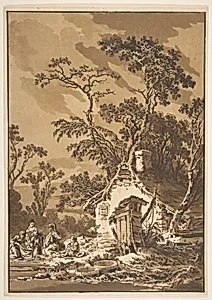
The Washerwomen (Les Laveuses)
Medium
Etching and aquatint printed in brown ink
Dimensions
sheet: 13 3/8 x 9 9/16 in. (34 x 24.3 cm)
Classification
Prints
Department
Drawings and Prints
Museum
Metropolitan Museum of Art, New York, NY
Credit
The Elisha Whittelsey Collection, The Elisha Whittelsey Fund, 2010
Accession Number
2010.543
Rights
Public Domain
Tags
Art Historical Context
Jean-Baptiste Le Prince's *The Washerwomen (Lesaveuses)*, created in 1771, captures a serene moment of everyday labor in a rural setting. The etching depicts women engaged in washing clothes, surrounded by modest houses and trees, evoking the simple rhythms of working life. Le Prince, a French artist for his genre scenes inspired by his travels in Russia, infused his works with a sense of exotic authenticity, blending French elegance with Eastern European motifs during the Rococo era's fascination with the picturesque. This print is a technical marvel: an etching and aquatint executed in warm brown ink, measuring 13 3/8 x 9 9/16 inches. Le Prince was a pioneer in aquatint, a revolutionary intaglio process introduced to France around 1768 that allowed for subtle tonal gradations resembling watercolor washes. Printed in color rather than black ink, it achieved a painterly depth rare for the time, making it a standout in 18th-century printmaking. Housed in the Metropolitan Museum of Art's Drawings and Prints department, this piece from The Elisha Whittelsey Collection highlights the era's growing appreciation for humble subjects. It invites visitors to appreciate how art democratized the beauty of ordinary labor, bridging cultural worlds through innovative technique.
About the Artist
Jean-Baptiste Le Prince · 1734–1781
Comment on works: Genre; Landscapes; Portraits; Copper engraver; Illustrator; Master draughtsman