
The Watering Hole
1848
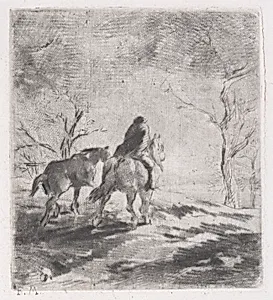
Medium
Drypoint and roulette
Dimensions
Sheet: 4 1/2 × 5 11/16 in. (11.5 × 14.5 cm) Plate: 3 3/4 × 5 in. (9.5 × 12.8 cm)
Classification
Prints
Department
Drawings and Prints
Museum
Metropolitan Museum of Art, New York, NY
Credit
Gift of William Loring Andrews, 1883, transferred from the Library
Accession Number
83.1.11
Rights
Public Domain
Tags
Art Historical Context
**The Watering Hole** (1848) by Charlesque captures a serene pastoral moment, likely featuring horses gathered at a watering spot amid rural landscapes. Jacque a French artist renowned for his animalier subjects, drew inspiration from the countryside, aligning with the emerging Barbizon school's focus on naturalistic scenes over idealized Romanticism. Created during the revolutionary year of 1848 in France, this intimate print reflects the era's growing appreciation for everyday rural life and the bond between humans (or in this case, animals) nature. Printed in drypoint and roulette on a modest plate measuring just 3¾ × 5 inches, the work showcases Jacque's mastery of intaglio techniques. Drypoint involves scratching directly into a metal plate for rich, velvety lines that convey texture and depth, while the roulette—a toothed wheel—adds subtle, burr-like shading for effects. This combination yields a delicate, tactile quality suited to small-scale prints, making it accessible for collectors. Housed in the Metropolitan Museum of Art's Drawings and Prints department, this piece—gifted in 1883—highlights 19th-century printmaking's role in democratizing art. Visitors will appreciate its evocative simplicity, evoking the quiet rhythms of farm life and Jacque's lifelong passion for barnyard creatures. (198 words)
About the Artist
Charles Jacque · 1813–1894
Charles-Émile Jacque (1813–1894) was a pioneering French painter, engraver, and illustrator whose career bridged the worlds of printmaking and pastoral painting. Born in Paris amid a difficult childhood, he apprenticed at age seventeen to a map engraver, mastering drypoint technique and producing his first etching in 1830—a copy of a head after Rembrandt. After serving seven years in the French Ar...