
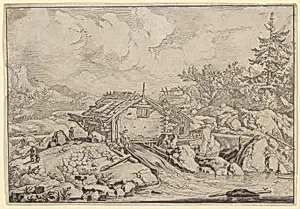
The Watermill
Medium
Engraving; fourth state of four
Dimensions
Sheet: 5 1/4 × 7 5/8 in. (13.4 × 19.3 cm)
Classification
Prints
Department
Drawings and Prints
Museum
Metropolitan Museum of Art, New York, NY
Credit
Gift of Harry G. Friedman, 1959
Accession Number
59.644.91
Rights
Public Domain
Tags
Art Historical Context
Allart van Everdingen’s “The Watermill” captures the quiet industry of a rural landscape through the precise lines of an engraving. A Dutch artist active during the Golden Age, van Everdingen became known for his detailed depictions of northern scenery after traveling to Scandinavia. His prints often highlight the interplay between human structures and the natural forces that power them, with watermills serving as enduring symbols of ingenuity and the rhythms of countryside life. Created as an engraving in the fourth and final state, the work demonstrates the medium’s capacity for fine detail and wide distribution. Engravings like this one allowed artists to share intricate scenes with collectors across Europe, turning everyday subjects into objects of contemplation. The modest sheet size invites close viewing, revealing the artist’s careful attention to textures of wood, water, and foliage. Housed in the Metropolitan Museum of Art’s Department of Drawings and Prints, this piece reflects the 17th-century appreciation for landscapes that celebrated both nature’s power and human enterprise. Its gift by Harry G. Friedman in 1959 ensures that visitors today can appreciate van Everdingen’s skill in transforming a simple watermill into a timeless vignette of Dutch artistic tradition.
About the Artist
Allart van Everdingen · 1621–1675
Allaert van Everdingen (1621-1675) was a Dutch Golden Age painter and printmaker who introduced Scandinavian landscape painting to the Netherlands. Born in Alkmaar and baptized on June 18, 1621, he pioneered a distinctive genre of Nordic mountain scenery that profoundly influenced Dutch landscape painting and later inspired the Romantic movement. Van Everdingen holds a unique place in art history...