
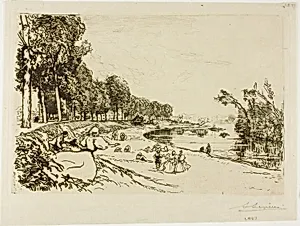
The Way to Billancourt
Medium
Etching in warm black on cream laid Japanese paper
Dimensions
Image: 16.8 × 25.3 cm (6 5/8 × 10 in.); Plate: 17.8 × 26.3 cm (7 1/16 × 10 3/8 in.); Sheet: 21 × 27.6 cm (8 5/16 × 10 7/8 in.)
Classification
etching
Department
Prints and Drawings
Museum
Art Institute of Chicago
Accession Number
46309
Rights
Public Domain
Art Historical Context
Step into the bustling outskirts of late 19th-century Paris Louis Auguste Lepère's *The Way to Billancourt (1894), a masterful etching that captures the industrial rhythm of Boulogne-Billancourt, a thriving suburb known for its factories and working-class vitality. Lepère, a prominent French printmaker and illustrator (1849–1918), excelled in depicting everyday urban life, blending Realism with the atmospheric sensitivity of Impressionism. This print evokes the era's rapid modernization, as Parisians commuted along tree-lined roads toward emerging industrial hubs. Rendered in warm black ink on luxurious cream laid Japanese paper, the etching showcases Lepère's virtuoso technique. Etching, an intaglio process where acid bites into a metal plate to create intricate lines and textures, allowed him to render subtle tonal gradations—from dappled light on foliage to the hazy distance of smokestacks. The choice of soft, absorbent Japanese paper enhances the ink's velvety depth, a nod to the fin-de-siècle revival of fine printmaking among French artists seeking alternatives to photography's rise. Housed in the Art Institute of Chicago's Prints and Drawings collection, this modest-sized work (image: 16.8 × 25.3 cm) invites viewers to ponder the poetry in the ordinary, bridging art and social history during France's Belle Époque. A gem for print enthusiasts!
About the Artist
Louis Auguste Lepère · 1849–1918
Louis-Auguste Lepère (1849–1918) was born in Paris on November 30 to the sculptor François Lepère, immersing him early in the artistic world. At age thirteen, he apprenticed in the studio of the English wood engraver Joseph Burn-Smeeton, training there from 1862 to 1867, and later attended drawing courses under Horace Lecoq de Boisbaudran at the Petite École (now École nationale supérieure des art...