
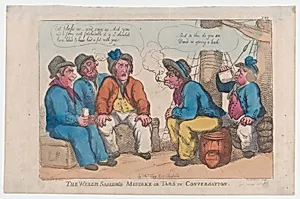
The Welsh Sailor's Mistake, or Tars in Conversation
June 30, 1808
Medium
Hand-colored etching
Dimensions
Sheet: 10 1/16 × 15 1/2 in. (25.5 × 39.4 cm) Plate: 9 9/16 × 13 11/16 in. (24.3 × 34.7 cm)
Classification
Prints
Department
Drawings and Prints
Museum
Metropolitan Museum of Art, New York, NY
Credit
The Elisha Whittelsey Collection, The Elisha Whittelsey Fund and Harris Brisbane Dick Fund, by Exchange, 1970
Accession Number
1970.541.8
Rights
Public Domain
Tags
Art Historical Context
Step into the lively world of early 19th-century British satire with *The Welsh Sailor's Mistake, or Tars in Conversation*, a hand-colored etching created by George Murgatroyd Woodward and Thomas Rowlandson 1808. Rowlandson, a master caricaturist renowned for his humorous and often bawdy depictions of everyday life, frequently collaborated with Woodward on prints that poked fun at social follies. This piece, produced during the Napoleonic Wars when British sailors—or "tars"—were national heroes, captures a boisterous tavern scene through exaggerated figures and witty details. The hand-coloring technique enhances the etching's vibrancy, bringing to life sailors smoking pipes, quaffing drinks, and engaging in rowdy conversation. The title hints at a comedic blunder by a Welsh sailor, playing on regional stereotypes and the rough camaraderie of naval life ashore. Such prints were affordable entertainments, sold in London shops to amuse the middle classes with their sharp social commentary. Housed in the Metropolitan Museum of Art's Drawings and Prints department, this work exemplifies the golden age of British caricature, blending humor with cultural observation. It offers a window into Regency-era leisure, where laughter bridged class divides and celebrated (or lampooned) the seafaring spirit. (198 words)
About the Artist
George Murgatroyd Woodward|Thomas Rowlandson · 1765–1809
**George Murgatroyd Woodward (1765–1809)**, often known as George “Moutard” or “Mustard” Woodward, was an English caricaturist and humor writer whose energetic, sometimes crude drawings captured the social follies of late Georgian Britain. Born at Stanton Hall in Stanton by Dale, Derbyshire, as the son of William Woodward, he grew up in the county before moving to London around 1791–92. Woodward ...