
The White Captive
1857–58; carved 1858–59
Medium
Marble
Dimensions
65 x 20 1/4 x 17 in. (165.1 x 51.4 x 43.2 cm)
Classification
Sculpture
Culture
American
Department
The American Wing
Museum
Metropolitan Museum of Art, New York, NY
Credit
Bequest of Hamilton Fish, 1894
Accession Number
94.9.3
Rights
Public Domain
Tags
Art Historical Context
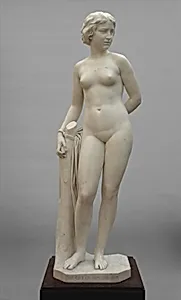
Erastus Dow Palmer's *The White Captive*modeled 1857–58, carved 185859) is a striking marble sculpture that captures the neoclassical ideal of feminine beauty amid themes of vulnerability and resilience. Standing nearly life-size at 65 inches tall, this American work depicts a young woman with a nude torso, her wrists delicately bound and adorned with feathers evoking Native American imagery. Palmer, a self-taught from upstate New York, drew from classical traditions while infusing his pieces with 19th-century American narratives. Created during a turbulent era of westward expansion and U.S.-Native American conflicts, the sculpture reflects popular "captivity narratives"—romanticized stories of white settlers taken by Indigenous peoples. Its marble medium, prized for its luminous translucency, allowed Palmer to achieve a polished, ethereal finish reminiscent of ancient Greek and Renaissance masters, elevating a contemporary subject to timeless artistry. Housed in the Metropolitan Museum of Art's American Wing through the bequest of statesman Hamilton Fish in 1894, *The White Captive* stands as a milestone in American sculpture, showcasing Palmer's skill in transforming local lore into universal human drama. Visitors are drawn to its poignant blend of grace and tension, a window into mid-19th-century cultural imagination.